Twitter share

Thursday, August 06, 2015

Stolen Art Watch, Gardner Museum Releases Art Heist Dry Run Video

Latest Gardner Art Heist News:
http://stolenvermeer.blogspot.co.uk/2015/08/stolen-art-watch-joseph-salvatore.html

Will William Youngworth be arrested, will Myles Connor be bought in for questioning, Gardner Art Heist Rollercoaster, the plot thickens !! 

Allegedly, William Youngworth Had Antiques Business Nearby Where Gardner Museum Security Guard Richard Abath Lived !!

Art Hostage has learnt that William Youngworth has been put in the frame for having access to the Eagle which a reward was offered for earlier this year. The $100,000 reward has been made in an attempt to get William Youngworth to reveal the whereabouts of the Eagle.
The alleged back story is one of Robert (Bobby) Donati, whom Myles Connor alleged to be one of the Gardner art heist thieves, perhaps the driver who was outside the Gardner Museum in the car, stole the Ku bronze vase and Eagle as a gift for Myles Connor knowing of his interest in things Oriental and interest in history?
Whilst Miles Connor was in Jail it is also alleged William Youngworth was tasked to hold all of the art collection of Miles Connor, including any Gardner artworks, which William Youngworth duly did.
Myles Connors
Furthermore, it is alleged William Youngworth sold most of the Myles Connor art collection, not the alleged Gardner artworks, whilst Myles Connors was in jail and this led to falling out between William Youngworth and Myles Connor.
Therefore, back in the late 1990's when William Youngworth stepped forward and offered to recover some of the Gardner art he had access to some Gardner art, the bronze vase, Eagle and possibly some lesser valued artworks such as the Degas drawings?  William Youngworth has always maintained he could recover some of the Gardner art if he was offered full immunity and had public guarantees of the reward being paid.
Perhaps this could be the latest attempt to offer up some Gardner artworks and claim the reward as well as try to hide behind the offer of immunity?
A friend of William Youngworths has been trying to act as a broker to get the Eagle back this year and things are allegedly ongoing .
It will be interesting to see if indeed any Gardner artworks, Eagle, Ku bronze vase, Degas drawings, as lesser valued Gardner artworks, are recovered and how the FBI, Prosecutors and Museum respond? 

Allegedly, William Youngworth Had Antiques Business Nearby Where Gardner Museum Security Guard Richard Abath Lived At The Time Of Gardner Art Heist 1990 !!

Art Hostage was told a long time ago that Richard Abath, the security guard on duty the night of the Gardner art Heist has been under close scrutiny by the FBI for a long time and has had his every movement monitored in a similar vain to that of Robert Gentile.
The FBI was also instrumental in getting the reward offer for the Eagle of $100,000 publicly released earlier this year in the hope Richard Abath would seek out to claim the reward via a proxy.
The FBI has also tried to put in undercover proxies to try and smoke out Richard Abath in a similar vain to Robert Gentile.
It is alleged that the Gardner museum was robbed twice on that fateful night, first by Richard Abath and his friends, or Richard Abath stole the Eagle etc and put them outside the museum in a rubbish sack, before the two thieves dressed as Police turned up. The Eagle, bronze Ku vase, as well as possibly several drawings and maybe the Monet were taken by the friends of Richard Abath and the hope was to blame the actual thieves who later arrived with their theft.
After all these years FBI have been using all their resources to try and trap Richard Abath and there is a possibility Richard Abath may face arrest shortly?
Richard Abath has thwarted all attempts thus far to bite, but maybe, just maybe we will hear of breaking news shortly.
There was a rumour that the Eagle had been recovered but that goes along with the rumour that one or more of the drawings had been recovered years ago.


Federal authorities have released new evidence in the notorious burglary of Boston’s Isabella Stewart Gardener Museum ­— footage of an unauthorised person entering the museum through the same doors as the thieves, but 24 hours before the $500 million in paintings were stolen.
Investigators hope that, even 25 years later, the public can help them identify the person or the automobile seen in the video that night, and they are offering a $5 million reward for information leading directly to the recovery of all of the missing artworks.
The low-resolution surveillance video shows a vehicle pull up to the museum’s rear entrance and an unidentified man walking out of the automobile and being let into the museum by a security guard. Federal investigators say the automobile matches the general description of the vehicle seen moments before the theft on March 18, 1990.
“Over many months we have engaged in an exhaustive re-examination of the original evidence in this case. Our aim has been to ensure that all avenues have been explored in the continuing quest to recover these artworks,” U.S. Attorney Carmen Ortiz said in a statement.
The footage was captured at 12:49 p.m. on March 17, 1990, almost exactly 24 hours before the thieves entered the museum through the same door.
“Today we are releasing video images from the night before the theft — images which have not previously been seen by the public — with the hope of identifying an unauthorised visitor to the museum,” Ortiz said. “With the public’s help, we may be able to develop new information that could lead to the recovery of these invaluable works of art.”
Two white men dressed as Boston police officers walked into the museum, handcuffed the security guards, and pilfered 13 paintings worth an estimated $500 million by names like Vermeer, Rembrandt, Degas and Manet. While the thieves took with them the security tapes from that night, they did not steal the tapes from the previous night, which investigators hope could break open the case.
No one has been charged in connection with the theft, and none of the paintings have been found. In 2013, the FBI said members of an East Coast crime organisation orchestrated the daring theft and then tried selling a share of their $500 million haul in Philadelphia a decade ago but they refused to divulge names.
Prosecutors have long suspected Robert Gentile, an ageing reputed Connecticut mobster, has information on the heist. Prosecutors revealed in a court hearing on unrelated weapons charges earlier this year that Gentile was caught on surveillance discussing the whereabouts of two of the stolen paintings with an undercover FBI agent and how much he could get for them. Gentile has repeatedly denied knowing anything about the heist.

Portland may play role in solving mystery of 1990 Boston art heist

The FBI suspects that a mobster transferred some of the 13 stolen paintings from the Isabella Stewart Gardner Museum to an associate outside a local seafood restaurant in 2003.
BOSTON — Although more than 100 miles away from where the masterpieces were stolen, FBI investigators believe that Portland plays a central role in solving the 25-year mystery of what remains the largest art heist in world history: the theft of artwork from the Isabella Stewart Gardner Museum.
Specifically, investigators are interested in what took place at a Portland seafood restaurant where Robert F. Guarente and Robert V. Gentile, two aging criminal associates who had long been friends, sat down with their wives in 2003 to enjoy lunch.
During their chit-chat, Guarente, who’d been freed from federal prison on a cocaine trafficking conviction the year before, told the Gentiles that he was dying of cancer and he was living his last days at his home in the central Maine town of Madison.
Years later, Gentile (who couldn’t recall the restaurant’s name) and Guarente’s widow agreed that she had ordered twin lobsters for lunch, but they had contradictory accounts on what had taken place after they had finished their meals. Elene Guarente told FBI agents in 2010 that the two men went into the restaurant’s parking lots and her husband opened the trunk of their car and handed over two or three paintings to Gentile.
Although she was fuzzy on some details, Elene Guarente said she believed the paintings were among the 13 pieces of art stolen from the Isabella Stewart Gardner Museum in 1990 and that they had long been held by her late husband at their home in Madison.
Although FBI agents have worked tirelessly chasing down hundreds of leads in the 25 years since the paintings were stolen, what Elene Guarente told them had taken place at the Portland restaurant remains the best tip investigator say they’ve received.
Elene Guarente, who still lives in Maine, was unsure why her husband had given Gentile the paintings – perhaps for safekeeping by Gentile or to turn over to another criminal associate. But she told the agents – and later a federal grand jury – that Gentile had placed the paintings in the trunk of his car and driven off with his wife back to their home outside Hartford.
Federal agents soon found reason to be heartened by what Elene Guarente had told them. When confronted with her account, Gentile acknowledged that he had in the past conversed with her husband about the Gardner theft and the two had schemed on how they might assist in getting back the stolen artwork and securing the $5 million reward that the museum offered for their recovery.
Later, the agents found, in the basement of Gentile’s home, a handwritten note on a sheet of typewriter paper that set out what each of the stolen pieces might bring on the black market.
Gentile insisted that it all amounted to empty talk between two old criminal associates and he never had gotten any paintings from Guarente after their lunch at the Portland restaurant. Nor did he know or believe that his old pal, Guarente, had the stolen Gardner paintings. The authorities, however, continue to believe Elene Guarente’s account and treat her version of the events at the Portland restaurant as the biggest break in the case.
But their efforts to gain a confession from Gentile have failed, though they charged him with involvement in criminal activity in 2012 and again this March. He is now on trial on charges he violated the terms of parole by meeting with other mobsters as well as selling a loaded pistol to a former convict.
Now 79, Gentile told a federal judge at a recent hearing that he believes he will die in prison because he is incapable of complying with federal prosecutors’ demands that he turn over the paintings stolen in 1990.

The Isabella Stewart Gardner Museum Art Heist And The Connecticut
In 1990, two men dressed as police officers walked into the Isabella Stewart Gardner Museum in Boston, overwhelmed two security guards, and walked out with 13 valuable pieces of art, including masterpieces by Rembrandt and Vermeer.
For 25 years the FBI, the Boston Police, and many journalists have interviewed suspects and investigated tips in hopes of solving the case. The museum has offered a $5 million reward for the return of all the stolen pieces.
But the art works are still missing. And no one has ever been arrested in the case.
The heist remains the largest art theft in U.S. history. The works stolen are valued at $500 million.
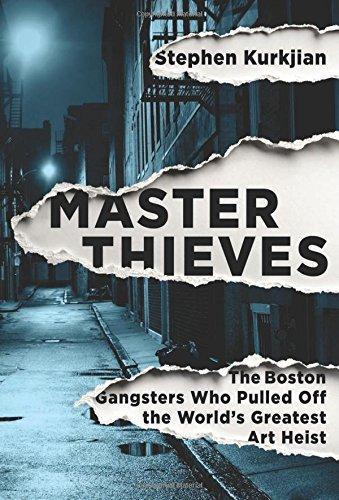
Stephen Kurkjian has investigating the Gardner Museum theft for about 18 years. He started working on the case as a journalist for the Boston Globe. He’s just published a book called Master Thieves. The book examines the people potentially connected with the heist and the FBI’s theory of what happened. Kurkjian says the FBI believes a criminal network that runs from Boston to Maine and even to Hartford is responsible for the theft.
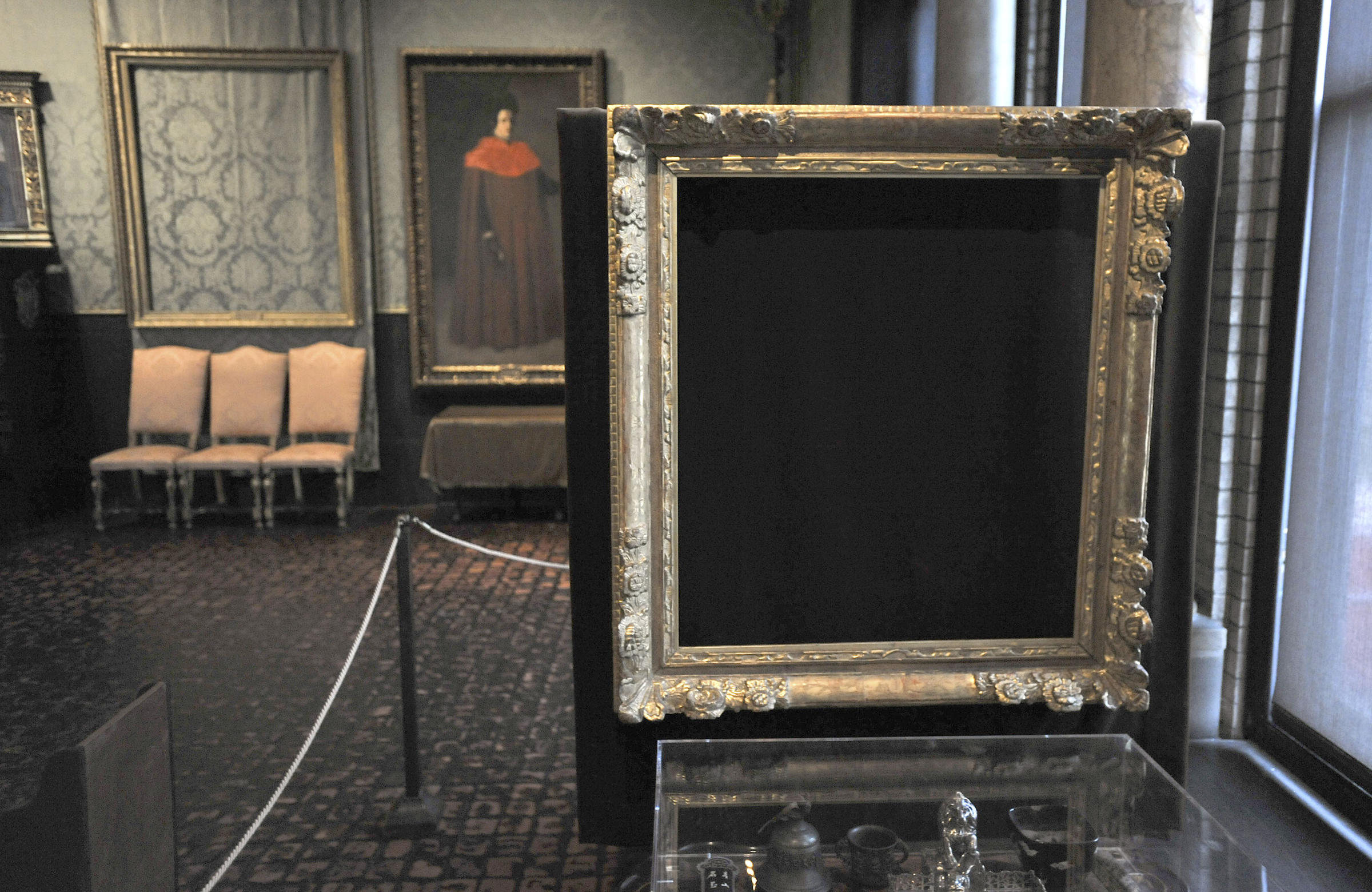
Thieves took "Storm on the Sea of Galilee,” by Rembrandt, which once hung on the wall in the left background and "The Concert," by Vermeer, which once occupied the frame in the right foreground. The empty frames remain on display at the Isabella Stewart Gardner Museum in Boston.
Credit (AP Photo/Josh Reynolds, File)
INTERVIEW EXCERPTS:
Your book highlights a broad cast of characters and includes a complicated network of low and high level criminals as well as two rival crime families.
I think that's at the center of the of this perplexing mystery. There were two gangs in the Boston area that knew of the vulnerability of the museum back as far as the late 70s and early 80s. These two gangs went at each other in a war because the control of the Boston underworld had become open with the death of Raymond Patriarca who was the gangland "uberboss" of all of New England. So that opened it up to two gangs, one overseen by a gang leader named Frank Salemme and another one overseen by newer, younger, much more aggressive men that sprung out of the North End of Boston. The FBI looks to the Salemme gang. In my research, I was able to make inroads into the second gang, and there I got the "eureka" moment in which I found out who in that gang knew of the museum's vulnerability and why they had the motive to break in.
You say finding a motive for the robbery really narrows down the field of suspects. Isn't that something that investigators should figure out fairly soon in the investigation?
You would think. But I think it was because the FBI got so overwhelmed with tips and information that came, for the most part if not solely, from fraudsters and con men seeking to get money out of the museum. They had to chase down everyone of these leads. I was told by the FBI lead agent in the case in 2010 that they had yet to have a confirmed proof of life sighting of any of the 13 pieces. And what that means is they have never gotten a photograph of any of the pieces, or a forensic piece of evidence of any of the pieces. That told me that the FBI was working very diligently, but they got a center where they felt the were right on it. So frustrating, but I think it's at the core as to why this case has never been solved.
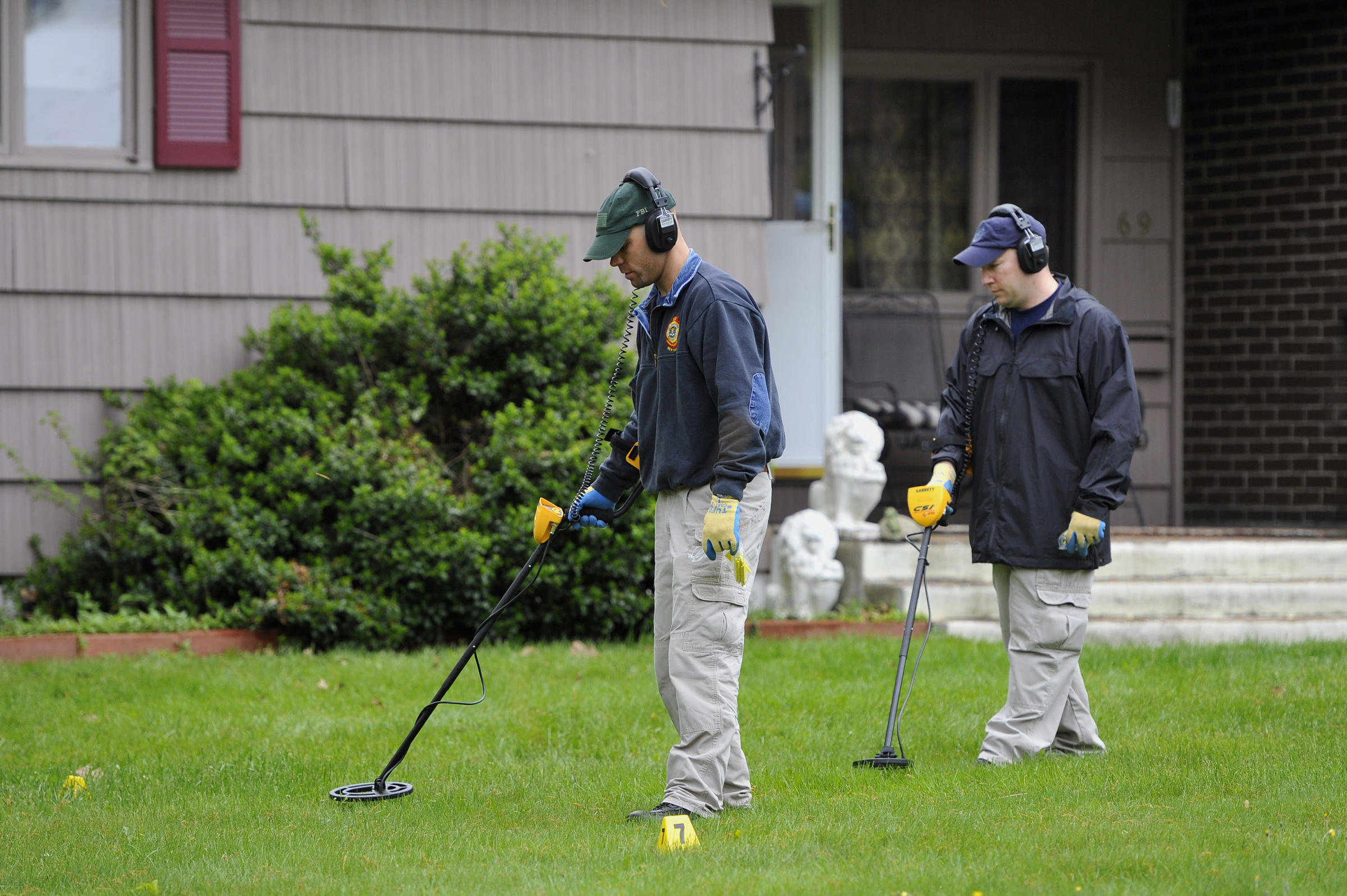
Law enforcement agents search the yard at the home of reputed Connecticut mobster Robert Gentile in Manchester, Connecticut, Thursday, May 10, 2012.
Credit (AP Photo/Jessica Hill)
There's some reason to believe that some or all of the art work was hidden for a time in Manchester, Connecticut.
Bobby Gentile is an aging mob associate. The FBI believed he was involved because of the testimony of the widow of his best friend who said that before her husband had passed away in 2004 he had given two or three of the paintings to Bobby Gentile. And Bobby Gentile had hidden them in his home somewhere in the shed in his backyard in Connecticut. When the FBI first approached Bobby Gentile in 2010 he agreed to cooperate, but that stopped in 2012. And then in 2014 the feds sent an undercover agent, an old pal of Bobby Gentile They talked about a crime that the old pal wanted Bobby to get involved in. Bobby fell into the trap. He said, "if you let me into this scheme you've got planned I'll sell you two of the paintings for half a million dollars." In my heart of hearts I don't think Bobby can get us back the paintings, but the feds are not convinced of that.

Convicted leader of New Jersey crime family who inspired Tony Soprano has died aged 90, marking 'the end of a mobster generation'

  • John M Riggi ran the DeCavalcante crime family for two decades
  • Ordered murders from behind bars, made labor racketeering 'an art form'
  • He was the inspiration for James Gandolfini's ruthless character
  • But detectives say he was a beloved figure, unlike fictional Tony Soprano
The convicted leader of a New Jersey crime family who inspired The Sopranos TV show has died.
John M Riggi, 90, ran the DeCavalcante crime family for more than two decades - even ordering murders and receiving payments while in prison for extortion and murder.
Under his ruthless rule, the gang developed labor racketeering into an art form, crime experts say. 
But unlike the character Tony Soprano, played by the late James Gandolfini, he was also a beloved member of the community. 
Archetypal mobster: John M Riggi took the helm of the DeCavalcante crime family in 1988 and 'turned labor racketeering into an art form'. He ordered murders from behind bars but was beloved in the community
Inspired: Riggi was supposedly the inspiration for James Gandolfini's character Tony Soprano in the hit show
Robert Boccino, former deputy chief of the State Organised Crime Bureau, told NJ.com: 'He wasn't Tony Soprano. Absolutely he was no Tony Soprano. The people in Elizabeth loved him. Nobody would co-operate – that was the problem. He was respected.'
And the effect he had on other prisoners was astounding, Boccino said as he reminisced about arresting Riggi in the 1980s. 
'All the others we took in that morning put on the arrest suit – sweats and sneakers. But when we brought him into the holding cell and he walked in, they all stood up. He was an impressive guy.'
Riggi's death, according to retired detectives, marks the end of a generation.
He died on Monday at his home in Edison, Corsentino Home for Funerals said. A cause of death wasn't disclosed.
Officially, he was the longtime business agent for Local 394 of the Laborers International Union of North America.
Tweaks: Unlike Tony Soprano (right), Riggi was supposedly a 'charitable' and 'popular' man between murders
But behinds the scenes, he was one of the East Coast's most notorious and feared mobsters. 
He was acting chief from about the mid-1970s to the mid-1980s. From the moment he took the helm in 1988, Riggi's family wielded its power over labor unions.
Officials also noted that he was known for supporting community groups and charities.
In September 2003, Riggi admitted his role in the 1989 murder of a Staten Island businessman that prosecutors said was supposedly carried out as a favor to John Gotti, the former head of the Gambino crime family. 
They said evidence at prior trials showed Riggi believed the slaying would improve the Decavalcante's position among mob families.
Sopranos creator David Chase has said he drew inspiration for the HBO show partly from crime families including the DeCavalcantes.

Saturday, August 01, 2015

Stolen Art Watch, Gardner Art Heist/Whitey Bulger/John Connolly August 2015


Mobster Tied To Boston Art Heist Assails FBI Tactics

Hartford mobster tied to notorious art heist calls FBI tactics "outrageous government misconduct."
The Hartford mobster who the FBI believes might be the last, best hope of recovering half a billion dollars in art stolen from Boston's Isabella Stewart Gardner Museum says the tactics that authorities are using to force his cooperation amount to "outrageous government misconduct."
Robert "Bobby the Cook" Gentile, who the FBI believes once had two of the stolen paintings and might be able to help unravel the continuing mystery of the missing art, complains in a new court filing that the FBI has twice used informants to induce him to commit crimes only so that agents and prosecutors could use threats of imprisonment to persuade him to talk about the stolen art.


Gentile, who is 79 and in jail, has said repeatedly that he can't tell the authorities anything about the notorious1990 Gardner heist and the missing art, even if he would like to, because he never had any of the stolen art and knows nothing about the robbery or what happened to the missing masterworks.
Gentile attorney A. Ryan McGuigan of Hartford argues in a long-shot attempt to win dismissal of charges related to Gentile's alleged sale of a gun to one of the informants that the FBI is abusing its formidable law enforcement power by contriving crimes solely to advance the investigation of an unrelated crime.
"In the instant case, the Government was not conducting a firearms sting investigation," McGuigan wrote in the motion. "It was not concerned with taking the armorer of the underworld in Connecticut out of commission. As the Government made clear immediately after taking Mr. Gentile into custody by its offer of cooperation in the Gardner Museum investigation, the alleged gun transaction at issue was pretextual."
The U.S. Attorney's office declined to respond.
What is not in Gentile's motion to dismiss is an explanation of why, over the past five years, Gentile has twice taken the bait offered by FBI informants and allegedly committed crimes.

In 2012, he was charged and convicted after he said that a persistent FBI informant persuaded him to illegally sell prescription painkillers. Earlier this year, in the case he is trying to dismiss, Gentile was charged with selling a pistol and ammunition to another informant, an old friend convicted in the killings of three people during a 50-pound marijuana robbery in the 1980s.
McGuigan said Gentile was told that he could avoid prison in both the drug and gun cases if he cooperated with museum investigators. But Gentile has said he has nothing to offer, even after being promised immunity and a chance at collecting the $5 million reward that the museum is offering for return of the art.

Multiple witnesses located by the FBI over decades of investigation have cast doubt on Gentile's claims. They have said that Gentile had possession of at least two paintings or that he implied that he had access to them.
An expert on the Gardner heist, perhaps the world's most baffling art who-done-it, speculates that Gentile either has some knowledge of the robbery or is the "unluckiest man alive."
The most important of the witnesses implicating Gentile is the widow of a Boston mobster who Gentile acknowledges was a friend and associate from the 1980s until the mobster's death in 2004. The widow told Gardner investigators early in 2010 that she was present when her husband handed two of the stolen paintings to Gentile outside a Portland, Maine, hotel between 2002 and 2004.

Gentile, in repeated interviews, said he met the mobster and his wife for lunch or dinner at Portland restaurants several times, but denies being given paintings. Gentile said the widow is "a liar," who implicated him because she was broke in 2010 and trying to get the $5 million reward.
Gentile and his attorney contend that he has been the subject of continual FBI surveillance since his friend's widow put him at the center of the Gardner case. Authorities have said that Gentile is a sworn member of a Boston Mafia crew. Gentile denies that charge, too, saying that he simply cooked and ran card games for gangsters. He said that's how he got his nickname.
Gentile said the FBI told him he would die in prison as a result of the 2012 drug arrest if he didn't help locate the paintings. Instead, he was released after serving 30 months. He faces a far longer sentence if he is convicted of selling a gun and ammunition as a convicted felon to another convicted felon.
Some of the most important art ever created disappeared about 1:30 a.m. on March 18, 1990, as St. Patrick's Day celebrations wound down around Boston. Two men dressed as police officers bluffed their way into the museum, a century-old, Italianate mansion that was full of uninsured art and protected by an outdated security system
Among the missing art: a Vermeer, a Manet and five drawings by Degas. Two of the paintings — "Storm on the Sea of Galilee," Rembrandt's only known seascape, and Vermeer's "The Concert" — could be worth substantially more than $100 million.

$10 Billion Worth Of Stolen / Lost Art Discovered In Mexican Drug Lords House

Eduardo Almanza Morales is a Mexican drug lord of Los Zetas. In March 2009, Almanza Morales was listed as one of Mexico’s top 5 most wanted drug lords. He had been linked to the introduction of illegal drugs into Mexico from Belize and Guatemala on behalf of the Gulf Cartel. Some sources have reported that Eduardo Almanza Morales was killed by Mexican law enforcement during a shootout in December 2009. However, as of 3 March 2013, he was still listed as wanted
Details have been made public today, stating that Morales was captured in Mexico. He was discovered as part of a 2 year joint operation between the DEA and Mexican Fedarales. Morales was found living in a huge mountain side villa, tucked away in the Mexican countryside.
The fact that this drug lord has been arrested is not what is making the news though. What officials found inside his villa have shocked the world. Morales had gathered the most expensive collection of art in history. Whats even more amazing is that ALL of this art and treasures had been stolen.
Officials are amazed that Morales went to all the effort to buy this priceless art collection, only for it to be confiscated by the DEA.
The art world has gone into meltdown with this news, the much awaited press conference will display some works of art that have been missing for over 50 years.
The collection has been valued at around 10 billion dollars. To put that into perspective, the value of the art work discovered could pay for healthcare for every man, woman and child in America for the next 12 years.
Here is a list of some of the more expensive paintings that where discovered :
Portrait of Adele Bloch-Bauer I by Gustav Klimt : Value = $135,000,000
image
Portrait of a Young Man by Raphael : Value = $130,000,000
image
The Concert by Johannes Vermeer : Value = $120,000,000
image
“Charing Cross Bridge, London” (1901) by Claude Monet : Value = $120,000,000
image
Landscape with an Obelisk by Govert Flinck : Value = $115,000,000
image
“Waterloo Bridge, London” (1901) by Claude Monet : Value = $115,000,000
image
The Storm on the Sea of Galilee by Rembrandt van Rijn : Value = $110,000,000
image
Poppy Flowers by Vincent van Gogh : Value = $55,000,000
image
Also discovered :
View of the Sea at Scheveningen by Vincent van Gogh : Value = $30,000,000
Congregation Leaving the Reformed Church in Nuenen by Vincent van Gogh : Value = $30,000,000
View of Auvers-sur-Oise by Paul Czanne : Value = $20,000,000
Nativity with St. Francis and St. Lawrence by Caravaggio : Value = $20,000,000
Le pigeon aux petits pois by Pablo Picasso : Value = $20,000,000
The Just Judges by Jan van Eyck : Value = $20,000,000
In addition to the priceless art works, officials discovered gold and diamonds with a total weight that exceeded 1 metric ton (1000 kilograms). Including crowns, statues made of gold, diamonds as big as apples and a gold plated swimming pool.
70 Million dollars worth of diamonds in this small box.
image
This crown was stolen from the Vatican in 1974 and is estimated to be worth over $160,000,000 due to its religious significance.
image
There was even a life sized solid gold statue of Kate Moss…
image
Morales also had a collection of some of the rarest animals in the world.
The Tibetan Mastiff is one of the most costly dogs that you can take home as a pet. The average price of this particular breed runs to about $582,000. Morales had a pack of 15 Tibetan Mastiff’s, its rumored that he would feed his enemies to the dogs.
image
White lions come from an extremely rare lion breed and cost between $100,000-$300,000 each. Morales had over 20 different types of “Big Cat” – Also rumored to be a favored way to dispose of the bodies of his enemies.
image
His bird sanctury housed some of the worlds rarest species. Including Toucan’s, Hyacinth Macaw’s, Palm Cockatoo’s. He even had an albino Golden Eagle which is said to be worth millions.
image
Oh yeah, they also found over 2 billion dollars in US banknotes.
image
All that paid for by drug money from American heroin addicts.

Court upholds conviction of ex-FBI agent tied to gangster 'Whitey' Bulger

A Florida appeals court on Wednesday reinstated the 2008 murder conviction of Boston mob boss James "Whitey" Bulger's longtime FBI handler for providing information the gangster used to carry out a 1982 hit.The state's full Third District Court of Appeals reversed its own decision of a year ago, which had found that the former agent, John Connolly, had been wrongly convicted and sentenced to 40 years in prison for his role in the murder of John Callahan, the president of sports betting operation World Jai-Alai.
Bulger's notorious Winter Hill gang had targeted Callahan for death because it wanted to take over the highly profitable operation.
In a 6-4 ruling, the full appeals court found that a three-judge panel had erred last year when it overturned Connolly's conviction for second-degree murder for providing information that Bulger's gang used to carry out Callahan's killing.
The decision hinged on whether a lower court acted properly in allowing a gun charge to be attached to the murder charge, which extended the statue of limitations. The appeals court on Wednesday upheld the lower court's decision.
"Because the reclassification of the defendant's conviction for second-degree murder was based on his personal possession of a firearm during the acts he committed during the commission of the murder ... the reclassification of the second-degree murder was not fundamental error," the majority wrote in its opinion.
Bulger was convicted of crimes including 11 murders he committed or ordered in the 1970s and '80s, including Callahan's. His 2013 trial revealed his corrupt relationship with federal law enforcement officials including Connolly, who turned a blind eye to the Irish-American gangster's crimes in exchange for information they could use against the Italian-American Mafia, then a top FBI target.
Lawyers for Bulger, who is serving two consecutive life terms in prison, argued in federal appeals court on Monday that his conviction should be overturned because he was not given a chance to testify. The judge had blocked Bulger from testifying that he had been granted immunity by a now-dead Justice Department official.
Connolly, a veteran FBI agent who retired in 1990 and has proclaimed his innocence, recruited Bulger as a mob informant. Bulger has denied serving as an informant, insisting that he paid agents for tips but provided none of his own.


Friday, July 10, 2015

Stolen Art Watch, Gardner Museum's Anthony M Amore Offers $100,000 For Eagle As He Masters The Art Of The Con

Genuine $100,000 REWARD

FOR INFORMATION LEADING DIRECTLY TO THE RECOVERY OF THE NAPOLEANIC FINIAL STOLEN FROM THE GARDNER MUSEUM IN 1990

The Isabella Stewart Gardner Museum is offering this reward for information that leads directly to the recovery of this item and guarantees complete confidentiality to any person or persons who come forward.
Please contact Anthony Amore at the Isabella Stewart Gardner Museum at
617 278 5114 or via email at theft@gardnermuseum.org.
Your confidentiality is ensured. http://www.gardnermuseum.org/news/theft

'Art of the Con' paints revealing picture of scammed collectors


Late last month, an art dealer named David Carter pled guilty to seven counts of fraud in a British court for passing off cheap bric-a-brac paintings he found on the Internet as originals by Alfred Wallis, an early 20th century painter known for producing marine scenes that toyed with perspective and depth. This comes just weeks after a pair of German men were accused of trying to ply a fake Alberto Giacometti sculpture to an undercover detective. The plot — it's a thick one — involved one of the men's 92-year-old ex-mother-in-law and an infamous Dutch forger who once kept an entire warehouse full of knock-off Giacometti bronzes.
Dip into the news on any given month and chances are you will find similar stories about art world ignominy, from the British copyist churning out oils attributed to Winston Churchill to the Manhattan dealer pushing looted Indian artifacts. There is something irresistible about that point where art and crime intersect: the money, the egos, the jet-set country club types — not to mention all the talk about provenance and brush strokes and craquelure (those cracks that form in the varnish of painting as it ages).
Anthony M. Amore would know a thing or two about the world of art swindles. For the last decade, he has served as head of security at Boston's Isabella Stewart Gardner Museum, which was famously robbed in 1990 of several Rembrandts and a Vermeer. Three years ago he published, with investigative journalist Tom Mashberg, the book "Stealing Rembrandts: The Untold Story of Notorious Art Heists," which explored the colorful history of thefts of works by the 17th century Dutch master, an activity that has involved machine guns and speed boats.
Now Amore is back with a new book that explores similar territory. "The Art of the Con: The Most Notorious Fakes, Frauds, and Forgeries in the Art World" looks at some of the most high-profile cases of art skulduggery from the last couple of decades. Each chapter tells the story of a single case, such as that of convicted German art counterfeiter Wolfgang Beltracchi, whose faked canvases based on the works of surrealist Max Ernst and modernist Heinrich Campendonk were so well executed that they successfully fooled even the artists' families (as well as actor Steve Martin, who unwittingly purchased a bogus Campendonk).
Likewise, there's the tale of West Hollywood gallerist Tatiana Khan, who claimed to be dealing works from the collection of the late real estate mogul Malcolm Forbes and who, at age 70, was busted by the FBI in a wild web of lies after selling a fake Picasso for $2 million. By the time the authorities caught up with her, she was in ill health, living in a jumbled house stuffed full of sculptures and antiques — like some sort of frayed "Miss Havisham character," writes Amore. (She ultimately pled guilty and was sentenced to five years probation.)

In this manner, "Art of the Con" takes the reader through a whole spectrum of cases, from the high to the low. There is the esteemed New York art dealer who ended up in jail after deceiving a star-spangled array of high-profile clients. And there's the case of the couple from La Cañada Flintridge who produced unauthorized ink jet prints of lesser-known artists' works for a fraud operation that extended into the world of cruise ship auctions. (Surreal and enlightening.)
While Amore recounts each of the cases efficiently from beginning to end, what's missing is more psychology. Early on in the book, he notes that a good art con isn't just about creating a good fake, it's about inventing a probable narrative to go with it: "The art of art scams is in the backstory," he writes, "not in the picture itself."
And while he diligently conveys some of these backstories (down to the vintage family photos faked by one forger), he overlooks some big-picture questions: What makes something art? Why is art such an entrancing symbol of power? What kind of person flips a $17-million painting by Jackson Pollock as an investment? And why are so many people so willing to ignore the warning signs of a sham deal?
"Art of the Con" is methodically researched and reported but does little to illuminate the process of seduction that takes place when it comes to acquiring art. Buyers can do their due diligence: They can check the provenance, they can analyze the market, they can consult with the pedigreed experts. But there comes a point in many deals where acquisition is guided entirely by intangibles such as status and beauty and a desire to possess — not to mention a healthy dose of greed. Ultimately, it is in this messy gray area that a more compelling story could have been mined and told.
The Art of the Con
The Most Notorious Fakes, Frauds, and Forgeries in the Art World
Anthony M. Amore
Palgrave Macmillan: 272 pp., $26
carolina.miranda@latimes.com.

Wednesday, July 01, 2015

Stolen Art Watch, Gardner Art Heist, Yin V Yang

‘Master Thieves’ and ‘The Art of the Con’

The Gardner Museum thieves cut the artworks out of their frames during the 1990 robbery. Credit From "Master Thieves"
On March 18, 1990, at 1:20 in the ­morning, two men dressed in police uniforms demanded entrance to the Isabella Stewart Gardner Museum. When the guard at the front desk complied, they bound him and his partner in handcuffs. “This is a robbery,” the intruders announced. “Don’t give us any problems, and you won’t get hurt.” The senior guard was quick to respond. “Don’t worry,” he said. “They don’t pay me enough to get hurt.”
Inadequate funding was just one of many problems undermining security at the museum when it was hit with the greatest art theft in history. Bequeathed to the city of Boston by Isabella Stewart Gardner in 1924, the art-filled palazzo had scarcely been renovated since her death, restricted by a will prohibiting significant changes. Nor were the guards well chosen: One of the night watchmen often ­conducted rounds while high on marijuana. His partner used the vacant museum for trombone practice.
As Stephen Kurkjian shows in “Master Thieves,” the museum’s inadequacies were matched only by the thieves’ carelessness. Major artworks by Rembrandt, including “The Storm on the Sea of Galilee,” were thrown on the floor to break their protective glass, and then sliced out of their frames with knives. Though a first-rate Vermeer was also part of the haul, the Gardner’s most valuable work, Titian’s “Rape of Europa,” was completely ignored. Instead the thieves nabbed some of the museum’s most trivial objects, like an ancient Chinese vase worth a few thousand dollars.
“This was not a surgical strike,” ­Kurkjian writes with understatement, dismissing the popular notion “that there was a ‘Doctor No’ figure who had commissioned the heist to get his hands on a favored painting.” Working as an investigative reporter for The Boston Globe, Kurkjian has spent much of the past couple of decades trying to figure out who the crooks were and what they were after.
He’s hardly been alone in this endeavor. Ranking the Gardner theft as one of the world’s Top 10 art thefts, the F.B.I. has continuously investigated the heist for the past 25 years. Yet despite countless man-hours and a $5 million reward offered by the Gardner’s trustees, the paintings have stubbornly remained out of sight. More than just a summation of all that’s publicly known about the case — from the thieves’ false mustaches to the F.B.I.’s sting operations — Kurkjian’s book is an impressive attempt to solve the crime by reconsidering the evidence.
Kurkjian does so by focusing on potential motives, starting with a bit of Boston street wisdom, supplemented by an anonymous tip. “During the Mob’s heyday in Boston,” he writes, “just about every criminal in the city believed that the return of a valuable stolen artwork could shorten a prison sentence or even make it go away.” In 1989, that wisdom was put into action when a powerful gangster named Vincent Ferrara was convicted of racketeering. Needing his protection from a rival Boston gang, a fellow mobster named Robert Donati orchestrated the heist, Kurkjian believes, in order to put Ferrara back on the street. However, according to Kurkjian, the overwhelming response to the theft forced Donati to hide the stolen art. Then he was murdered, and the paintings have been missing ever since. And so when it comes to locating them today, Kurkjian surmises, the intricacies of long-ago gang warfare “might just unlock the mystery.”
It’s a plausible theory, if not incontrovertible, and Kurkjian has shared it with the F.B.I. and the Gardner Museum’s head of security, Anthony M. Amore. There’s reason to believe that Amore might be sympathetic, judging from how he characterizes art theft in his own new book, “The Art of the Con”: “High-value paintings are rarely stolen by crooks that can be characterized as professional art thieves,” he writes. “The reason for this is simple: Highly valuable and recognizable masterpieces . . . are exceptionally difficult to fence.” From the thief’s perspective, priceless art is worthless. “The art of art theft is said to be in the selling of the art, not the thievery,” Amore elaborates, comparing it with the art of fraud, which he claims “is in the back story, not in the picture itself.”
And fraud is the central subject of “The Art of the Con.” Following the formula of his first book, “Stealing Rembrandts,” Amore has compiled an assortment of old cases, rehashing past crimes. Some will be familiar to newspaper readers. (One chapter recapitulates the forgery scandal that led to the 2011 closure of Knoedler & Company, one of New York’s most venerable galleries.) Others are obscure for good reason. (Another chapter describes how a Los Angeles art dealer named Tatiana Khan passed off a forged Picasso pastel, claiming it came from the Malcolm Forbes collection. She was caught and convicted, end of story.) Amore brings little insight to these case histories, assembling his narratives from newspaper articles, court records and the occasional interview with law enforcement colleagues.
Nevertheless, some frauds are so interesting that even Amore’s bland retelling can’t quash them. For the manipulation of back story — or provenance, as art professionals call it — few can best Ely Sakhai. In the 1990s, Sakhai began buying second-rate paintings by first-rate Impressionists, purchasing at auction in New York. He would have each of these ­artworks meticulously replicated (including the back of the canvas and frame) by a team of Chinese copyists. Then he would sell the copy with the original certificate of authenticity and auction record to a Japanese collector. Later he would have the original reauthenticated and resell it in New York.
Wolfgang Beltracchi was even more creative in his fabrication of provenance — as he had to be, since his forgeries were never direct copies. Beltracchi specialized in Modernists. Studying their style and using period materials, he would paint the masters’ “unpainted works” (as he provocatively phrased it), contributing new art to their oeuvres.
In order to explain the sudden appearance of undocumented masterpieces, Beltracchi cast his wife’s deceased grandfather as a prewar German collector, claiming that the seller was the German Jewish dealer Alfred Flechtheim, whose records were lost during the Third Reich. (Beltracchi supported this provenance by sticking fake Flechtheim Gallery labels on the back of his paintings.) Hundreds of Beltracchi’s forgeries were sold in the 1990s and 2000s, often at public auction, for prices as high as several million ­dollars. One fake was exhibited in the Metropolitan Museum of Art. What brought Beltracchi down was neither connoisseurship nor historical research but the detection of an anachronistic pigment in one of his paintings.

Amore attributes Beltracchi’s feat of deception to skill with paint and ­cleverness with provenance. Less obviously, he credits Beltracchi’s all-­encompassing ego. “In fact, his hubris may have been the essential part of his success,” Amore writes. It’s a point worth considering: Can a kind of greatness be attained through delusions of grandeur?
But if hubris is intoxicating to the art forger, it’s toxic for an art investigator. All of Amore’s stories end in punishment, an unrealistic representation of criminal activity. More misleadingly, Amore presents scientific analysis as an infallible new weapon against fraud. In fact, investigators’ overconfidence in scientific detection techniques has been exploited by forgers for at least the past century.
Hubris may even be what’s holding up the Gardner Museum investigation. Kurkjian revealingly shows how the F.B.I. has systematically shut out lower echelons of law enforcement like the Boston police, despite their superior knowledge of local gangs. Journalists are held in equal contempt: Kurkjian reports that neither the F.B.I. nor Amore has bothered to follow up on his investigation of Robert Donati’s surviving contacts and family.
What makes Kurkjian’s book so gripping is precisely the quality lacking in Amore’s: an accomplished investigator’s sense of open-minded humility.

Friday, June 05, 2015

Stolen Art Watch, Gotcha, All's Well That Ends Well, Boston Strong !!


Two missing artworks found at Boston Public Library

The found artworks were displayed by Boston Public Library officials.
Boston Public Library
Lauren Schott (right), who found the prints, displayed the Rembrandt while president Amy Ryan held the Dürer.

Two valuable prints that went missing from the Boston Public Library, triggering a criminal investigation and the resignation of the institution’s president, were discovered Thursday on a shelf — a mere 80 feet from where they should have been filed, according to authorities.
“It’s a cloud lifted, a burden off our shoulders,” a jubilant Amy Ryan, the library president, said in a telephone interview. “Everyone is happy.”
She said the discovery, a day after she announced her resignation, doesn’t change her plans to step down. Yet she feels vindicated, she said, knowing that the prints — an Albrecht Dürer engraving valued at $600,000 and a Rembrandt etching worth up to $30,000 — are found.
“Someone just said this to me, and it’s true: Nothing is missing under my watch,” Ryan said. Other items reported missing, she said, “went missing years before I started at BPL.”
When pressed about whether someone could have taken the prints and returned them, Melina Schuler, a library spokeswoman, said library officials were confident that the prints had been in the library all along, misfiled a year ago in a simple case of “human error.”


The prints were discovered at the library’s Copley Square branch around 2 p.m., just as two Boston Police officers and a federal prosecutor investigating the missing artwork arrived for a tour of the massive room — the size of a city block — where the print collection is stored, according to a law enforcement official.
The Dürer and Rembrandt prints were found resting one on top of the other, along with a third unidentified print, on a metal shelf, more than 6 feet from the ground, according to the official, who spoke on the condition of anonymity because he was not authorized to speak.


David L Ryan/Globe Staff
Amy Ryan (right) looked over the found art in the rare books room.
Despite the discovery, a criminal investigation into how the prints were handled is proceeding.
“The anticorruption unit will continue trying to determine if anything else is missing,’’ said Boston Police Commissioner William Evans. “We will be examining what they have there. The investigation is not over.”
Mayor Martin J. Walsh received a phone call from Ryan on Thursday afternoon alerting him that the artwork had been found.
That news, he said, “was certainly a lot better than worrying about an inside job as far as stealing the art. I asked her if any of the other stuff that was missing was found, and she said no.”
Walsh said he would not speculate on whether the artwork had been removed and returned, or was in the same place throughout the investigation.
Walsh added, “I’m going to make sure we investigate the missing pieces that are left and come up with protocols so things like this don’t happen again.”
The FBI and the US Attorney’s office will continue to assist in the ongoing probe, according to spokeswomen for those agencies.
Dürer’s “Adam and Eve,” and Rembrandt’s “Self-Portrait With Plumed Cap and Lowered Sabre,” were found in the library’s storage room in Row 14B, Bay 3 on Shelf 2, about 80 feet from where they should have been filed, according to library officials.
“I was shocked to find the two prints, but it really was just luck of the draw,” said Lauren Schott, the library conservation officer who found the prints, in the statement.
“Any one of the team that’s been looking for the Dürer and Rembrandt could have found them.”
The items were found during an eight-week search of the stacks. Fourteen library workers searched through 180,000 of the print stacks’ 320,000 items — about 60 percent of the inventory, the statement said.
In addition to the search of the 8,300-square-foot room containing the stacks, employees also searched nine offices, work rooms, and reading rooms, library officials said.
Ryan said members of her staff knew the Dürer was missing in June 2014, but didn’t tell her until April 10. She said she launched a search, believing it may have been misfiled, then notified police on April 15 when it was discovered that the Rembrandt was also missing.
During a meeting of the library trustees on Wednesday, Ryan said the Dürer was last seen on April 2, 2014, when it was viewed by a group of students, and was discovered missing on June 10, 2014, when another class was supposed to view it.
The library placed Susan Glover, a longtime librarian who oversees the library’s special collections, on paid administrative leave in April.
Police launched an investigation April 29 and said they were looking into the possibility that the artwork had been stolen by employees.
On Thursday, Glover’s lawyer, Nicholas DiMauro, said Glover had cooperated fully with police and had always maintained the prints were misplaced.
“She felt, and I felt very strongly, that she would be vindicated,” said DiMauro, describing Glover as a person of high integrity who is well-regarded in the library community and among benefactors who have donated valuable pieces to the library.
“She, in her heart, believed at all times and said repeatedly that the prints had been misplaced, that it’s happened many times and they will be found,” DiMauro said.
The discovery that the valuable prints were missing brought intense scrutiny on the library’s security protocols and collection practices.
Ryan acknowledged that the library has no central inventory list of what it owns, and there is no catalog of each item.
During Wednesday’s trustees meeting she said she inherited a system in which her predecessors voraciously acquired collections for the library, but didn’t keep records to accompany them.
“The system is flawed and antiquated and it needs to be addressed immediately,” DiMauro said.
The Rembrandt print and the Dürer were supposed to be filed in separate boxes in the library.
Library officials believe the Rembrandt was likely viewed along with the Dürer, when it was last seen, then misfiled, according to Schuler.
“It is not unusual for two prints by two different artists to be shared in one sitting. It was not surprising that they were together,” Schuler said. “The prints were misfiled. This was a matter of human error. That’s how the library feels about this.”
The Dürer and Rembrandt have been put in their proper places.
The library said it received e-mails in recent weeks alleging that several scores of music donated 20 years ago by the family of Boston-area composer William Thomas McKinley were stolen “a few years later,” and gold coins that were once stored in a time capsule in the cornerstone of the McKim building have also vanished.
Rembrandt’s “Self-Portrait With Plumed Cap and Lowered Sabre” (right) is an etching, Albrecht Dürer’s “Adam and Eve” (also known as “The Fall of Man”) an engraving.
MUSEUM OF FINE ARTS
Rembrandt’s “Self-Portrait With Plumed Cap and Lowered Sabre” (right) is an etching, Albrecht Dürer’s “Adam and Eve” (also known as “The Fall of Man”) an engraving.
Shelley Murphy can be reached at shelley.murphy@ globe.com. Andrew Ryan can be reached Adam.Ryan@ globe.com.

Wednesday, May 20, 2015

Stolen Art Watch, Boston Strong, Copley Square Public Library Scrambles To Check Collection As Durer & Rembrandt Go Walkabout

Art is reported missing at Boston Public Library

The Boston Public Library in Copley Square.
Police are investigating the disappearance of two works of art worth more than $600,000, including a print of a Rembrandt self-portrait, that went missing last month from the Boston Public Library’s flagship branch in Copley Square, authorities said Tuesday.
A report from the Boston Police Department’s Anti-Corruption Unit states that officers learned in April that two prints, the one by Rembrandt and an Adam and Eve etching by Albrecht Dürer, were missing. 

The Dürer piece was valued at over $600,000, and the Rembrandt was worth between $20,000 and $30,000, according to police and library officials.
Library officials learned of the missing prints on April 8 and police were alerted April 29.
Asked about the delay in reporting the matter to police, a library spokeswoman, Melina Schuler, wrote in an e-mail that staff “conducted an initial review and search of likely locations the prints might have been misfiled before turning the matter over to police.”
A police spokesman said the anti-corruption unit typically investigates suspected criminal wrongdoing by city workers. The spokesman declined to say whether a library employee was suspected of stealing the prints, however.

In a statement, the library system’s president, Amy Ryan, said officials had “recently discovered that an engraving by Albrecht Dürer and an etching by Rembrandt are missing from the Boston Public Library’s print collection. It is our hope that these two significant pieces have simply been misfiled. The curators and department staff are currently conducting a detailed search of the collection, and we are working with the Boston Police Department to determine if there is the possibility of criminal activity,” she said.

The library is “undertaking an updated inventory of the more than 200,000 prints and drawings that make up the print collection,’’ and that it will also “conduct an independent analysis of security protocols,” she continued.
She added that “while strict procedures for viewing items in the collection are in place, it is always a balance to fulfill our obligation to make collections open to the public to study and enjoy, while preserving them and keeping them secure.”

“The collections of the Print Department, with more than 200,000 prints and drawings, are stored in designated secure areas of the Central Library at Copley Square,’’ Schuler said. “The missing prints were not on display.’’
One library employee said Tuesday that workers keep a close eye on what goes in and out of the rare book section. “You have to sit at the restricted tables to review books,” he said. “You couldn’t just walk out with anything.”
Another worker said she was not surprised to learn of the disappearance of the artworks, since “anything can happen, it’s a public space. Maybe there wasn’t enough security that time.”
Both workers declined to be named because they did not have permission to speak publicly on the matter.
According to library officials, the Dürer etching was engraved in 1504 and is approximately 8 inches by 11 inches in size. The Rembrandt self-portrait was produced in 1634 and is roughly 5 inches by 6 inches, officials said.
Dürer was a painter, printmaker, and theorist from Nuremberg who lived from 1471 to 1528, according to the website www.albrecht-durer.org.
“His watercolours mark him as one of the first European landscape artists, while his ambitious woodcuts revolutionized the potential of that medium,” the website states.
Rembrandt lived from 1606 to 1669 and his iconic paintings include “The Syndics of the Cloth Guild,” “Bathsheba,” and “Jacob Blessing the Sons of Joseph,” according to the website www.rembrandtpainting.net.
The library owns 30 Rembrandt prints and 105 prints by Dürer, and the works are part of the library’s “small but interesting collection of Old Master prints and drawings,” according to its website.
Councilor Joshua Zakim, who lives near the library, said he was disturbed to learn that the artwork had gone missing.
He said any disappearance “of city property I would take seriously, never mind priceless pieces of art. I’m glad to hear that the [Police Department] is investigating.”
The disappearance of the artwork comes 25 years after thieves stole $500 million worth of masterpieces from Boston’s Isabella Stewart Gardner Museum. Those paintings have never been recovered.
“It sounds like, certainly, a very serious matter,” Zakim said of the disappearance of the library artworks. “I want to make sure that I can do whatever I can in the community . . . to make sure we get to the bottom of it.”

Paul Hendry, a former trafficker of stolen art who is based in the United Kingdom, wrote in an e-mail that “most likely there was an opportunity and it was taken, by someone like a worker working inside the print area, but if indeed there has been a distinct lack of accounting then there might be more than just these two prints gone.”

Jan Ransom and Shelley Murphy of the Globe staff contributed to this report. Travis Andersen can be reached at travis.andersen @globe.com. Follow him on Twitter @TAGlobe.

Libraries face challenge to balance public access, security

 https://www.bostonglobe.com/arts/theater-art/2015/05/20/artwork-public-display-poses-unique-security-problems/mlUT4h7EcgAwTMhAn6f8RK/story.html

Barry Landau brought cupcakes before he palmed documents from the Maryland Historical Society. Daniel Spiegelman used a dumbwaiter shaft to gain access to Columbia University’s Rare Book and Manuscript Library. Zachary Scranton used a variation on the classic bait-and-switch to pilfer a rare book from Ohio’s Rutherford B. Hayes Presidential Center library.
And Daniel Lorello, who pocketed valuable historical documents from the New York State Archives, had perhaps the ultimate advantage: He worked there.
Their methods may have varied, but these thieves’ aims were similar: They were after maps, rare books, manuscripts, and memorabilia — the precious but often poorly guarded items that are housed in many of the country’s libraries, rare-book collections, and archives.
And while police continue to investigate how artworks by Dürer and Rembrandt went missing from the Boston Public Library — and the possibility it was an inside job — the works’ absence points to a seemingly intractable problem as archivists and librarians try to secure their collections, while also leaving them open to public study.
Perhaps most difficult to prevent are thefts by the employees themselves, as illustrated in the Lorello case. The longtime employee at the New York State Archives was sentenced to prison after admitting that he stole hundreds of documents valued at tens of thousands of dollars from the state’s collections. His scheme, which went on for years, was discovered only after a history buff saw an item Lorello had listed on eBay.

“It’s almost impossible to prevent insider theft. You have to trust someone,” said Travis McDade, curator of law rare books at the University of Illinois College of Law. “You have guys that have unlimited access, and have what they consider a good reason to steal.” Their reasons, he explained, can range from mounting debt, to a desire to study an object more closely or preserve it at home, to mere greed.
Striking a balance between access and security is “the conundrum that all are facing,” said Gregor Trinkaus-Randall, a preservation specialist at the Massachusetts Board of Library Commissioners, who has written extensively on archival security. “Custodians have the responsibility of taking care of these materials . . . but, at the same time, they also have the responsibility of providing access to them in a safe and secure manner both to protect the items and to enhance research. It is a balancing act.”
While art theft usually grabs the headlines, theft of archival materials — everything from historical letters and maps to individual pages of books — is in many ways more insidious and harder to track. Whereas a stolen painting is a one-of-a-kind object that often leaves a blank spot on the wall, archival materials can be missing for years before someone notices they are gone.
“Libraries are good victims, because they won’t be discovered missing until someone wants to see the book or the archival document,” said McDade. “This allows the thief time to sell it and maybe it will change hands two or three more times before it’s discovered missing.”
But even when an object’s absence is discovered, it can take months to determine whether the item was stolen or simply misplaced — as still could be the case at the Boston Public Library. Such uncertainty makes many libraries hesitant to report a theft.
“Libraries used to not report these things at all,” said McDade. “They didn’t want potential donors to think they were a sieve, so they’d keep these things from the press and the authorities, and try to understand what happened in-house.”
McDade, who authored a book about Spiegelman’s dumbwaiter scheme, added that archival materials present a particularly easy target. Many of the thieves are themselves archival experts: longtime researchers who inevitably become chummy with librarians, causing staffers to become less vigilant.
“That’s why it’s hard to detect, because they’re from the population of people who go to archives,” McDade said. “You go to these locations and you spend days doing research, so you develop a relationship with them. Nine out of ten you don’t have to worry about, but then there’s that tenth.”
That was certainly the case with Barry Landau, the self-proclaimed presidential historian whom a judge sentenced in 2012 to seven years in prison for theft of historical materials estimated to be worth more than $1 million. Landau, a collector of presidential memorabilia who also admitted to having sold some of the documents, was not found out until an attentive library staffer saw Landau’s accomplice conceal a document and try to walk out.
“We can prevent the Barry Landaus with a little more assiduous defense and vigilance,” McDade said. He added that part of what makes archival materials such an attractive target is that, in addition to many libraries’ often-lax security standards, the objects themselves occupy a sort of historical and economic sweet spot. Unlike a painting, which is unique, there are often several copies of archival maps and documents. What is more, they are expensive enough to make it worth the thief’s while, but not so expensive as to attract attention.
RRembrandt’s “Self-Portrait With Plumed Cap and Lowered Sabre” (right) is an etching, Albrecht Dürer’s “Adam and Eve” (also known as “The Fall of Man”) an engraving.
PRINTS COURTESY OF THE MUSEUM OF FINE ARTS
Rembrandt’s “Self-Portrait With Plumed Cap and Lowered Sabre” (right) is an etching, Albrecht Dürer’s “Adam and Eve” (also known as “The Fall of Man”) an engraving.
“There will be a legitimate market because there are legitimate copies that are out there, and not everyone is going to know the provenance of each copy,” said McDade, adding that the market has exploded with the arrival of online auction sites like eBay.
“It gives them an almost limitless market,” he said. “Before the Internet, if you stole something you needed a reliable fence, or to find someone who doesn’t care about provenance. With the Internet all that risk goes away. You just put it online, where provenance is not as important as it is in a gallery or an antiquarian bookstore.”
Recently, many libraries have instituted best-practices standards in an attempt to secure their archives, with some going so far as installing surveillance cameras, monitoring what clothes people can wear in the reading room, and even weighing objects on scales when researchers check out. But these measures only go so far, and many experts say the most effective defense against theft is vigilant staff members who check identification, control how many objects are lent out, and have clear sightlines to the reading room.
“The best defense is a good offense,” said Daniel Hammer, deputy director of the historic New Orleans Collection and the senior cochairman of the security round table of the Society of American Archivists. “We create a research environment that’s very interactive with the staff, so at no time should there be someone accessing the material who isn’t in a relationship with a librarian.”
Following such measures might have saved Ohio’s Rutherford B. Hayes Presidential Center library from losing two rare books in 2008.
According to an affidavit, Zachary Scranton did not have identification when he asked to see the so-called Maxwell Code, a rare tome thought to be the first printed in Ohio. Instead of his ID, librarians held Scranton’s backpack as he looked at the book, which he stole while librarians were not looking.
When the library staff finally checked the bag, they found it stuffed with paper towels.
“So they gave him a $100,000 book, and he gave them a bag of paper towels,” said McDade. “You need to have basic protocols in place.”
Malcolm Gay can be reached at malcolm.gay@globe.com. Follow him on Twitter at @malcolmgay.

Disappearance of BPL art may be an inside job

Employee placed on administrative leave; FBI aiding inquiry

Boston police are investigating whether a Boston Public Library employee stole two art prints valued at more than $600,000 from the central branch in a theft that went undetected for as long as a year and raises concerns more artwork may be missing, authorities said Wednesday.
“We’re looking at the possibility of it being an inside job,” Boston Police Commissioner William B. Evans told reporters Wednesday, as authorities revealed that the FBI is assisting in the investigation.
One employee has been placed on paid administrative leave, said a library spokeswoman, who provided no further details.
Asked if any employees had been identified as suspects, Evans said: “I think we’re looking at some. . . . We’re looking at a few people inside who might have access to that particular area.”
The commissioner said he was informed that the prints may have been missing for up to a year.
One of the prints, an Adam and Eve engraving by Albrecht Dürer, is valued at over $600,000; the other, an etching of a Rembrandt self-portrait, is worth $20,000 to $30,000.
Evans said police were alerted a few weeks ago and immediately launched an investigation.
Library spokeswoman Melina Schuler told the Globe the library does not have images of the prints.
Mayor Martin J. Walsh said he was alarmed that the theft went undetected for so long and that library officials delayed notifying police.
He said it was also troubling that the library does not have images of the missing prints.
“We can’t have valuable treasures of the city of Boston disappearing,” Walsh said during a brief telephone interview Wednesday. “We need to catalog what we have and make sure we are keeping an eye on them. Prints can’t just walk out the door.”
Walsh called for a review of library security and said he would meet next week with the chairman of the library’s board of trustees and the library’s president, who is on a trip outside the country.
The mayor said he was unaware of other missing items.
“But certainly I have concerns,” he said.
The library president, Amy Ryan, said in a statement Wednesday that the library in Copley Square is working closely with police on the investigation and conducting an independent security review and an item-by-item audit of its print collection, which has more than 200,000 pieces.
“It is important that all of the treasures of our collection can be made available to the public now and in the future, and that must be balanced with ensuring their security,” Ryan said.
Schuler, the library spokeswoman, offered more details about the sequence of events. She said that when library workers discovered the Dürer missing April 8, they launched a search in locations where the print may have been misfiled.
On April 15, the staff discovered the Rembrandt self-portrait also was missing and notified the police commissioner and the mayor, she said. A police report was filed April 29, and the Boston Police Anti-Corruption Unit launched an investigation.
Jeffrey B. Rudman, chairman of the library’s board of trustees, said in a statement that the trustees have “endless confidence in President Ryan.”
Rudman said that Ryan notified police “when she first knew exactly what artwork was missing,” and that the trustees appreciated the efforts of Ryan and her staff “both in their cooperation with the police and in doing all that they can to maximize the likelihood that we will recover this art.”
Recently, the library enlisted an independent security firm, KCMS Safety and Security Solutions, to work with its staff to assess security systems in the print department and associated collections and to make recommendations for upgrades, Schuler said.
The artwork was stored in a print room that is closed to the public. Patrons who want to view items must complete a card with personal information.
Then, a staff member — roughly 10 to 20 people on staff are authorized to do this — retrieves the items from the print room, which is accessible only via staff elevators.
Rembrandt’s “Self-Portrait With Plumed Cap and Lowered Sabre” (right) is an etching, Albrecht Dürer’s “Adam and Eve” (also known as “The Fall of Man”) an engraving.
PRINTS COURTESY OF THE MUSEUM OF FINE ARTS
Rembrandt’s “Self-Portrait With Plumed Cap and Lowered Sabre” (right) is an etching, Albrecht Dürer’s “Adam and Eve” (also known as “The Fall of Man”) an engraving.
Patrons view the items in a reading room, which is locked and tucked in the rear of the rare books section, past glass cases that hold ancient books. They are not allowed to bring bags into the room, and they are monitored by a librarian.
Paul Crenshaw, an associate professor and chair of Providence College’s art history department, said Dürer, a 16th-century German artist, was the first major artist who dedicated himself to print making. The “Adam and Eve’’ print, he said, is among the best-known of his works.
The Rembrandt self-portrait is one of many done by the artist and far less valuable.
As for why someone chose those two prints from the library’s collection, which includes 30 Rembrandts and 105 by Dürer, Crenshaw said, “It probably tells you that someone knew what they were looking for and took something particular that they wanted.”
Anthony Amore, director of security at the Isabella Stewart Gardner Museum and author of two books on art thefts, said: “Thefts happen at libraries all the time. Most people are unaware that many public libraries have exceptional art collections.”
The Gardner Museum was the site of the biggest art heist in history. The 1990 theft remains under investigation by the FBI, the US attorney’s office, and Amore.
The items stolen from the Boston Public Library would be difficult to sell because it would be easy to determine that they were stolen, Amore said.
“My message to the thieves would be: ‘You have not stolen a picture. You have stolen problems,’ ” Amore said. “The best thing would be to get them back to the library and hope it ends there.”
Shelley Murphy can be reached at shelley.murphy@globe.com. Jan Ransom can be reached at jan.ransom@globe.com.

Vermeer's The Concert

Vermeer's The Concert