Twitter share

Wednesday, January 18, 2012

Stolen Art Watch, Charles Vincent Sabba Sheds New Light on Gardner Art Heist

Gardner Bullets IV: Simmons College Robbery


This is a small excerpt of a much longer Your Brush With The Law exclusive interview that will be posted here in March for the anniversary of the Isabella Stewart Gardner Museum robbery. This interview with William Youngworth III is going to reveal never before discussed details of the robbery and shed light onto the case.


CVS: Please shed light on the Simmons College robbery that occurred right across the street from the Gardner Museum eight years prior (1982) to the Isabella Stewart Gardner Museum robbery.

WY: Well, that night was our first trip into the Gardner Museum, our second was in like 1986 or 87. My god, its all such ancient history now. First I would like to address this criminal attachment to my name. In 1977 I was given a 13 year prison sentence for something I was cold blooded innocent of. I was identified as a get away driver in an armed robbery that I did not do...........


CVS: You weren't doing anything illegal back then?

WY: I wouldn’t go that far, but in my world back then it was then as legal as I could make it. I was working with a close friend making fake I.D.’s. My friend was a genius at photography. We were making licenses for Joe McDonald’s crew who used them in a horse racing fixing racket around the country. It all came tumbling down right about then.

We got $500 a piece for our I.D. kit which were so good that they could take a call from a cop if someone got pulled over. We had made our equipment portable. We were using the same equipment Massachusetts DMV’s were using. We would rent hotel rooms never in the same place twice, call Joe’s guys and tell them where to come. We would make ten I.D. kits per session, collect our $5,000 and be gone. We did it a few times per week and making good money for back then....

CVS: So how did you end up in the Gardner Museum?

WY: We first were walked through and shown the Gardner and we cased the museum a second time in 1986. Some guy that wasn’t in our crew got our ID cameras busted in a drug raid. He had been dealing coke right under our noses, which put our operation in jeapordy. He met this girl in a bar and brings her back to our safe house. One thing led to another, she saw too much, went to the cops and we lose all our equipment. During this same week we had a major ID order to fill. My other friend is this super connected guy in Boston and he put the world out we need Polariod 707 ID cameras and will pay $10,000 each for them. In less then two days we had a lead on some. They were in Simmons College in Boston.

CVS: The Simmons College robbery isn’t that widely known is it?

WY: I did let it out when I was pleading with the Gardner to act fast because I was losing my toe hold on my ability to assist them without it becoming drastically more complicated. They didn’t listen. But your right it was basically brushed aside. Funny, I’ve never had to prove how guilty I was before! Each time we looked at the Gardner Museum, we were cautioned that some of the frames were very possibly wired into the alarms. There were a lot of unknowns we were waiting for answers on. Before those answers came I had gotten picked up on an old charge.

CVS: For our readers that don’t know Boston, or haven’t been to the Gardner Museum, Simmons College and the Gardner are directly across a small street from one another.

WY: Anyway, my friend’s contact was the night time guard of the Simmons. Since the plan would give us the control over the entire college we cleaned out their Audio Visual lab and got our hands on equipment we had been wanting to lay our hands on for years.

CVS: This gets a little hard to ignore. Please tell us how Simmons was robbed.

WY: Sure. The exact same way the Gardner Museum was in 1990. It was knock, knock, "open up it’s the police". "Were here over a distress call we received". It took four of us, including the guard about four hours to clean the place out. We had a connection that ran a large commercial division of a rental truck company and had to get the truck back by 6:30AM before the day shift showed up at 7:00AM. This was our first tour of the Gardner. Our guard and their’s were both musicans and social buddies. Truthfully I never knew about the place and it was the Simmons guard who turned us on to the score. We got in there that night after we got done at Simmons. We put a look out up the street and he gave us the all clear for us to take the truck from around back of Simmon’s loading dock, a few hundred feet down Palace Road and around the block re-connecting to Huntintgon Ave.

CVS: What was the guard’s story who was involved? And you know I need to ask about your first trip into the Gardner.

WY: Certainly we’ll get back to that but his statement was that uniformed Boston Police Officers had handcuffed him, took him down into a basement stairwell and re-handcuffed him to a railing.

CVS: I have done some checking into this. Simmons has no comment about this, the Boston Police have such a brief report that’s it ridiculous and two paintings in the Dean’s office were cut from their frames.

WY: I actually believe that the original report was much more detailed. Actually I am certain of it. Our guard brought us a copy. We were actually using it as an information on the items we ended up selling and didn’t need. And your information about two paintings being cut from their frames is 100% correct. When our guard saw my friends ’passion’ for art he told us all about what was right next door.

CVS: You cut paintings from the frames?

WY: Heavens no! When I saw what he did I was very upset. These really weren’t that big a deal paintings. They weren’t worth much. Just two nice late 19th Century portraits of old faculty members. They were portraits of men and this is a women’s college. I recoiled when I saw what he had done. He didn’t really care and simply rolled them up. You know what, in re-telling that story I recall I never knew what happened to those paintings.

CVS: So let me get this straight. Right across the street from the Gardner, where eight years later a $500 million robbery occurs 100 feet away where the guard says he was summoned to the door by persons claiming to be police, the police over power the guard, hand cuff him in a basement, take control of the place and cut paintings out of frames...and that wasn’t a clue to investigators?

WY: That is correct.

For the rest of this exert please visit: http://www.yourbrushwiththelaw.com/intro.htm Roll Call

Rembrandt; oil on canvas; 2010; detail of larger canvas by Charles Sabba


Van Rijn; oil on canvas; 2010; detail of larger canvas by Charles Sabba


Storm on Sea of Galilee; Rembrandt Van Rijn; Stolen from the Isabella Stewart Gardner Museum.

Gardner Bullets V: A Sealed Case


Lets talk seriously now, and after over twenty years I think serious discussion is overdue since many of the principles have passed away, and if the few who are left go as well, they may take the secrets the possess with them, such as where the stolen art is (and we do believe the authorities know everything except WHERE the thirteen stolen items ended up). Seriously, the Gardner Museum security at the time of the robbery was a joke, so the museum administration and board members need to be held accountable and owe something to the American art loving people. They can rectify their negligence in the protection of our national treasures by taking drastic actions to recover the stolen art works. The head of security at the time of the robbery was incompetent and the guards were broken down valises who knew nothing about museum security. Why did these guards get off the hook so easy? Burnout musicians who opened the door to the museum even though the museum's policy clearly stated that they should never open the door for anyone. The Gardner guards allowed the robbers in and, after being duct taped up and secured to pipes in the basement, slept comfortably. Does a reasonable citizen relax enough to fall asleep into sweet dream land in this kind of situation while going through this kind of horrible ordeal? Then, after being discovered and liberated, these guards gave ridiculous descriptions to the police which culminated in those terrible composite sketches.

Two composite sketches of suspects: After Neville BPD; fingerprint ink on fingerprint card; Charles Sabba

Please recall (and refer to Gardner Bullets IV) that the Simmon's College guard was completely in on the 1982 robbery. Supposedly, the people who planned the Gardner heist never knew about the place until the Simmons guard turned them on to the score back in 1982, when he was covering for his pal at the Gardner Museum (the guard at the Gardner, a musician, was at a gig and the Simmon's guard was making his rounds).

It appears that the authorities are protecting these guards. The Gardner guard has never caught any public heat. These kids were no criminal masterminds, they could have never withstood the heat that they should have had to endure. I am positive they were pissing their pants in fear, being stuck between very dangerous underworld figures and the authorities/possible legal troubles. Please note the one little blurb in Tom Mashberg's & Anthony Amore's book about stolen Rembrandts that in Museum robberies it is usually an employee that is involved with thefts. There is usually an inside connection (and most museum security experts agree).

Where are they now? The Simmons guard died in the motor cycle accident. One of the Gardner guards supposedly died in France. One of the Gardner guards lived right around the corner from one of your William Youngworth's Allston antique stores at the time of the robbery. He allegedly was assaulted (reported recently in the Boston media) in front of the Allston antiques store. I personally would like to find and question all of the guards.

CVS: Why did Mashberg write about the guard living around the corner from the store on the twentieth anniversary of the heist?

WY: Who knows. Maybe its true. I didn’t know the guy. I vividly recall the argument I got into with Mashberg that started his attacking me the very next day. He probably printed the story to bait me into saying something about it. That was not so much a robbery as a gimme (staged robbery). I never saw two security guards on duty at anytime. That’s not to say there wasn’t but the security was a joke. In 1986 my friend had his own relationship going with a Gardner night security guard. The Gardner was just another score in the 80’s. In 86 we were just waiting for some security information. ...

CVS: During the negotiations with the Gardner Admin and the authorities, negotiations that eventually failed, did the authorities ask you to describe any of the circumstances of the theft? How about the condition of of the paintings? Did they ask to describe the backs, edges or under where the frame would hide?

WY: In the initial part of the negotiations they wanted me to describe things about the backs of the paintings I just did not know. They asked me about identification aspects that at the time I really never had a reason to note. They expected me to leave and go find those answers under intense surveillance. They obviously wanted me to access the package and lead them right to it. Now, many years later, as I understood it there was a Bernard Berenson tag on the piece and there were seals, or labels, that went between the stretcher bars and the canvas. The paintings were broken out of their frames and the seals were broken in the process.

These seals are designed to be like a seal indicating the actual artworks were original to the frames of that institution. Many museum collections do this. Its sort of a security/integrity feature ensuring the art work hadn’t been moneyed around with.

Read the full exerts at http://www.yourbrushwiththelaw.com/intro.htm

Coming soon Gardner Bullets Six and Seven

http://www.yourbrushwiththelaw.com/intro.htm

http://www.yourbrushwiththelaw.com/intro.htm

Thursday, January 12, 2012

Stolen Art Watch,Gardner Extention , "It's a Kind of Vast Municipal Fire Station A Monstrous Carbuncle on the Face of a Much-Loved and Elegant Friend"


Museum renaissance

Gardner to unveil grand new wing at reopening


In her will Isabella Stewart Gardner (1840-1924) stipulated that her museum, which she founded in 1903 and where she idiosyncratically installed her collection of fine and decorative art, remain largely unaltered. A copper-clad, four-storey-high building where a coach house formerly stood was never part of her vision, but this 70,000 sq. ft extension has been added to the museum that bears her name. Due to open on 19 January, the wing has been designed by the Pritzker Prize-winning Italian architect Renzo Piano and has cost $118m.

Anne Hawley, the museum’s director, says that her trustees decided to expand six years ago mainly because attendance had reached 200,000 visitors a year. The pressure on the building and the collection was too great, Hawley says, and limited space curtailed events and activities. When Gardner was alive, only 2,000 people enjoyed her recreation of a 15th-century Venetian palazzo, filled with paintings, tapestries, furniture, manuscripts and textiles, complemented by concerts in its music room.

Piano’s solution is a modern building that is not as tall and stands 50ft from the original museum. He compares the relationship between the buildings to that of “the great nephew to the great grand aunt”, says Hawley. Old and new buildings are linked by a glazed passage. The extension houses a 300-seat auditorium, a 2,000 sq. ft exhibition space, a cafĂ©, conservation labs and staff offices. It also provides a new, larger entrance.

Building the extension has been controversial, not least because Gardner designed the carriage house, which was demolished in July 2009. The Boston Globe revealed in May 2009 that concerned members of staff felt Hawley was suppressing debate over the building’s historical significance. The newspaper cited an essay by former curatorial fellow Robert Colby, in which he describes how the carriage house held symbolic value for Gardner. Hawley responded to objectors by saying the carriage house was “never part of the visitor experience” and was not protected by Gardner’s will.

The carriage house had been used to accommodate visiting artists, a function catered for in Piano’s extension, which includes two artists’ apartments. The museum’s board of trustees unanimously voted for the demolition and the city and the state’s preservation agencies, including the Boston Landmarks Commis­sion and the Massachusetts Historic Commission, did not object. The Supreme Judicial Court of Massachusetts ruled the demolition “in the public interest” because the museum’s plans for an extension would “extend the life of the [original] building” and fulfil Gardner’s will to establish a museum “for the education and enjoyment of the public forever”.

“For the first time we will have a real exhibition space to focus on certain objects in our collection,” says Oliver Tostmann, the museum’s research fellow, who is due to become the collection’s curator in April. He plans to select one or two objects from the collection each year and show them alongside objects from other institutions in the new space. The opening exhibitions will commemorate the 20th anniversary of the museum’s artist-in-residence programme.

Gardner was able to build a museum for her growing art collection when she inherited $2.1m from her father in 1891. He made his wealth in the Irish linen trade and later in mining investments. Gardner’s peers—and rivals for work by Titian, Botticelli and Michelangelo—included the likes of JP Morgan, Henry Clay Frick and Andrew Mellon, or the “squillionaires”, as she called them. “I’ve got the picture habit. It’s as bad as the whisky habit,” she confessed in 1896.

This isn’t your grandma’s Gardner.

Boston’s beloved Isabella Stewart Gardner Museum reopens next week with a design update and double the size, thanks to a new 70,000-square-foot wing, designed by Italian architect Renzo Piano.

“You can keep the life and beauty there, but you can tell a new story,” said Piano, who sat for an -interview in the new wing’s Living Room.

The sleek addition, connected by what Piano calls an “umbilical cord,” is four stories of glass and copper, and even the fire escapes are aesthetically pleasing. The museum opens to the public Jan. 19, with three community days of free admission.

Restoration of the Palace
Since 1990, the Gardner Museum has completed significant restoration work on the historic palace building to stabilize its structure and help accommodate increased programming and attendance. Projects have included replacing the skylight over the courtyard with thermal pane glass and installing a climate-control system. Construction of the extension complements preservation work that is ongoing within the historic building, including a decade-long lighting project to protect sensitive artwork and improve the visitor experience.

A centerpiece of the Museum preservation project is the Tapestry Room, which has been restored to its original glory after being used for 85 years as a temporary concert hall. As the Museum’s world-class concerts will now take place in the new wing’s Calderwood Hall, the Tapestry Room has been returned to its former configuration to be experienced as a grand tapestry hall. Conservation treatment of the space included the cleaning of its Mercer-tiled floors, restoration of the French medieval stone fireplace, reinstallation of select art and furniture objects, replacement of historic textiles with reproductions, and new lighting.

Art Hostage Comments:

Restoration of the Palace started in 1990, h.mmm, same time as the Gardner Art Heist ???

Of course we have been told from the get go the stolen artworks were not insured, h,mmmm ????

Then of course twenty years after the Gardner Art Heist $180 million is raised for this new extension, h,mmmm.

Again, of course we have been told the stolen Gardner artworks were not insured, h.mmmm ??????

The cost of the new extension is reputed to be around $118 million, h,mmmm, $62 million left in the pot, h,mmm.

Could the existing reward offer of $5 million for the recovery of ALL the stolen Gardner art "in good condition" be diverted from the left over $62 million to an escrow account and that news made public to tempt those who may hold the stolen Gardner art to come forward to collect the $5 million ?????

In light of the fact the $5 million reward offer was made all the way back in 1997 and the value of the stolen Gardner artworks have increased two three fold, increase the reward offer to $10 million and put it in an escrow account to show a sign of good faith and the willingness of the Gardner Museum to appear sincere ??????????? Would still leave $52 million in the pot.

In support of the doubling of the reward to $10 million and putting that into an escrow account, Could the FBI and Assistant DA Brian Kelly issue a complete immunity for those who recover the stolen Gardner Art and just focus on recovering the iconic Vermeer The Concert, Rembrandt's Storm On The Sea etc ???????

This would lead to the certain recovery of the Stolen Gardner Art and confirm the art is all that matters, as the public has been told numerous times by both Law Enforcement and the Gardner Museum.

Upon another note the Tapestry Room looks wonderful and bears testament to the legacy of Isabella Stewart Gardner.

However, the New Wing looks like "a monstrous carbuncle on the face of a much-loved and elegant friend" to quote Prince Charles.

Wednesday, January 11, 2012

Stolen Art Watch, Dr No Hans Heinrich "Heini" Thyssen-Bornemisz’s Collection Returns Stolen Art, Sadly Not Gardner Art


Hans Heinrich "Heini" Thyssen-Bornemisz’s Stolen & Looted Art Collection

http://universe.byu.edu/index.php/2012/01/10/police-beat-9/

Jan. 5 – Somewhere between 1970-1985, a piece of art valued at $218,000 was stolen from BYU campus. After being stolen the “Silver Chalice” was sold between a number of different art dealers before finally landing in Switzerland with Count Thyssen-Bornemisz’s collection. BYU negotiated with Thyssen-Bornemisz’s estate and the piece of art was returned to BYU.

Art Hostage Comments:

Alex Boyle, in an exclusive Art Hostage interview last summer, makes the connection between the Gardner Art Heist and the end destination for some of the elusive Gardner art being the Hans Heinrich "Heini" Thyssen-Bornemisz’s Stolen & Looted Art Collection:

http://stolenvermeer.blogspot.com/2011/07/stolen-art-watch-gardner-art-heist-alex.html

Sunday, January 01, 2012

Stolen Art Watch, Gardner Art, The Man Who Can, Patrick Nee

The Man Who Can Recover Some Gardner Art


Art Hostage Comments:

Give this man, Patrick Nee, blanket immunity from prosecution and a cast iron guarantee he will not have to testify against or reveal any sources, then the Gardner Art will surely be on its way home.

The small matter of the reward offer can be resolved by placing the $5 million in an Escrow account to show good faith and once the Gardner art is recovered then the payout is made.

Patrick Nee was not involved in the actual Gardner Art Heist or subsequent handling of the Gardner art, an honest broker who commands respect right across both the criminal and Law Enforcement Underworld.

Tuesday, December 27, 2011

Stolen Art Watch, FBI Agent Geoff Kelly Reveals, Gardner Case, Not An Inch, No Deals, No Reward,


Kelly's Heroes

The Duxbury Free Library begins the New Year with an old unsolved crime. At 2 p.m. Sunday, Jan. 8, the Sunday Salon Series will present FBI Special Agent Geoff Kelly, who will discuss the infamous art heist from the Isabella Stewart Gardner Museum. In March of 1990, 13 priceless works, including art by Rembrandt, Vermeer and Degas, were stolen from the museum. Twenty-two years later the art has not surfaced. Agent Kelly will share information about the heist and appeal to the public for information.

“The theft captured the public’s imagination because it was daring,” Kelly said. “But in the end, it’s still a theft, and the criminals need to be held accountable.”

To reserve your ticket, call the library now, at 781-934-2721, ext. 108.


Read more: Sunday Salon Series - Duxbury, MA - Wicked Local Duxbury http://www.wickedlocal.com/duxbury/fun/entertainment/arts/x1282423687/Sunday-Salon-Series#ixzz1hkTsOzP5

Art Hostage Comments:
Finally, Geoff Kelly reveals how the FBI want those who have information about the Gardner heist and subsequent handling of the art "held accountable"

Meaning, anyone who can provide information about the whereabouts of the Gardner art must be forthcoming and provide everything they know abut those who handle the Gardner art and also, vitally, must be prepared to testify to that extent to a Grand Jury and Trial jury.

Furthermore they will loose their fifth amendment rights and have the FBI comb all over their life so to check if there is any criminality lurking in the background that could be used against them at a further date.

Turning to the alleged reward offer of $5 million for the recovery of ALL the Gardner art IN GOOD CONDITION.

The offer speaks for itself, "all the Gardner art in good condition" subjective at best, dishonest at worse. We all know the Gardner art was ripped from their frames therefore some damage occurred at the time of the theft, let alone the intervening years being stored within the depths of the Underworld. A get-out clause for the Gardner Museum.

Notice anytime the reward offer is made in public the words "all of the Gardner art in good condition" are stated very clearly !!

Another consideration for anyone with information about the Gardner art whereabouts, there is no way on earth the Gardner Museum would pay one single dime without express approval of the FBI and the FBI will never approve any payment for the Gardner art without bodies, arrests and convictions.

Truth is the same as back in 1990, the Gardner art is stolen property and anyone with information is required to reveal all or face charges of withholding information and obstructing justice.

Any reward is subject to the discretion of the Gardner Museum and is non-negotiable.

Upon another note, it is alleged Whitey Bulger and Mark Rossetti have been offering their own insight into the Gardner case and this had led to the raiding of Anthony "Chucky" Carlo, plus ongoing inquiry's.

Thursday, December 22, 2011

Stolen Art Watch, Gardner Art Heist, Flip The Investigation To Recover The Art


"Frank and Jamie", installation/sculpture, 2002, by Maurizio Cattelan.

A new icon of subversion.
This sculpture is both an inverted image of power and a statement about the seduction of authority.

Over 20 years later, still pained by void where work of art should hang

http://bostonglobe.com/opinion/letters/2011/12/21/over-years-later-still-pained-void-where-work-art-should-hang/oxAmnZScTq5S3O795z90YP/story.html

TO THOSE who have the painting:

March 18, 1990, more than 20 years ago, my heart cried out: “The Storm on the Sea of Galilee’’ had been stolen along with a number of other valuable pieces of art. Twenty years later, my heart still cries out.

I had been fortunate. I had gazed upon the painting and pondered its meaning. Rembrandt urges us to consider taking a stormy sail with the apostles and Christ upon the sea of life. Rembrandt himself, who is believed to have depicted his image gazing out to us from the ship, invites us on board. The artist represents us, humanity with Christ.

After the heist, when I visited the Isabella Stewart Gardner Museum in Boston, I saw the blank spot and cried. My son and daughter, having never seen the painting, will never be blessed with the experience that only the original can provide. Countless others are being deprived of Rembrandt’s wish to inspire us.

Twenty years. It has been long enough. To those who have the painting, I say: Be good and return the piece; the world needs it. You will be forgiven; it is Christmastime. No questions asked. You have had this artwork long enough. Just send it.

P. Nelson

http://www.yourbrushwiththelaw.com/intro.htm

The Honorable Charles Vincent Sabba Reflects On The Gardner Art Heist Recovery Process

http://www.yourbrushwiththelaw.com/intro.htm

Gardner Bullets I: An Introduction


"Killer Bee"; 2006; 45 Cal target round, acrylic paint and fabric wings; by Charles Sabba.

http://www.yourbrushwiththelaw.com/intro.htm

Gardner Bullets II: Concealing and Receiving


It is a ten-year felony to conceal or receive any of the stolen Gardner Museum artworks:

http://www.yourbrushwiththelaw.com/intro.htm


The Isabella Stewart Gardner Museum door that the thieves entered on Palace Road on 18 March 1990.


United States Attorney for the District of Massachusetts Carmen M. Ortiz.

http://www.yourbrushwiththelaw.com/intro.htm

Gardner Bullets III: Is an offer of immunity on the table?

http://www.yourbrushwiththelaw.com/intro.htm


Portrait of a stool Pigeon; oil on canvas; by Charles Sabba.


http://www.yourbrushwiththelaw.com/intro.htm

Check out "The Wire" over on "Your Brush With The Law" for the Charles Vincent Sabba Art Crime lectures, news, interviews and video's relating to art crime and the Gardner Art Heist:
http://www.yourbrushwiththelaw.com/intro.htm

Tuesday, December 06, 2011

Stolen Art Watch, Gardner Art Stranded In FBI/Underworld Struggle


From the mouths of criminals

http://bostonglobe.com/metro/2011/12/06/from-mouths-criminals/XXLZxi5mBwnS3G41LK4UCO/story.html

The FBI’s cynical embrace of Mark Rossetti, a reputed killer and Mafia leader used as an informant, is reminiscent of the Whitey Bulger scandal, in which the nation’s premier law enforcement agency let a gangster eliminate his competition while he whispered sweet nothings in its ear.

But if a former Wakefield man sitting in a prison in Florida is telling the truth, the Rossetti case could be history repeating itself in a different way when it comes to putting people on ice to keep a sordid FBI deal from becoming public. From his prison cell, Michael Romano says he is preparing to sue the FBI and the Justice Department for framing him in an elaborate scheme to protect informant Rossetti. Romano says the FBI’s determination to protect Rossetti not only landed him in prison, but it also got his son and namesake, Michael Romano Jr., killed in 1994. It is an outlandish tale. And maybe the most outlandish part is that some or all of it could be true.

Mike Romano is no choirboy. And he admits he was trying to find out who killed his son, Mikey. He says that just when he was getting close to figuring out who did it, the FBI and Justice Department swooped in to take him and a faction opposed to then-Mafia boss Frank Salemme off the street. Romano says, and many in law enforcement agree, that Mark Rossetti was aligned with the Salemme group, which Romano believes was responsible for his son’s death. The FBI let Rossetti and his associates shoot and kill with impunity, Romano contends. “All we did was try to protect ourselves,’’ Romano said.

But the government says Romano was part of a crew that went gunning for the Salemme crowd. That crowd would have included Rossetti, the FBI’s prized snitch. Facing charges that could have landed him in prison for the rest of his life, Romano pleaded guilty in 1999 to charges that included plotting to kill Salemme. He is scheduled to be released in 2016.

The FBI did not respond yesterday to Romano’s statements.

Romano says a key witness against him - now retired FBI agent Michael Buckley, who was Rossetti’s handler - was acting to protect Rossetti, not the public interest, when the government accused Romano of offering $15,000 to anyone who took out Salemme. “This is the Teddy Deegan case all over again,’’ said Romano. That case cost taxpayers more than $100 million, paid to four men, two of them senior members of the Mafia, who served more than 30 years in prison after the FBI framed them for the murder of smalltime hoodlum Teddy Deegan. Those men were framed to protect an FBI informant. Romano says he is going to ask for $50 million.

Now, some people will ask, why believe a convicted criminal sitting in prison who has an ax to grind against those who put him there? That’s a fair question. But the true extent of the Bulger scandal was not exposed until career criminals and killers started talking: Stevie Flemmi, Kevin Weeks, John Martorano. They literally knew where the bodies were buried.

The only way we figure out the truth is to bring Mike Romano’s charges into the light. So far, there has been nothing from the FBI or Justice Department explaining why Rossetti was maintained as an informant for decades until the Massachusetts State Police arrested him last year or why an FBI supervisor lied when asked by State Police if Rossetti was their informant.

US Representative Stephen Lynch recently met with the FBI along with staff from the offices of Representatives Darrell Issa and Elijah Cummings, the chairman and ranking member of the House Committee on Oversight and Government Reform, and Senator Chuck Grassley, ranking member of the Judiciary Committee. The FBI said it was conducting an internal inquiry and promised a follow-up meeting. If prosecutors won’t hear Mike Romano out, there are congressional investigators who are willing to listen.

Saturday, December 03, 2011

Stolen Art Watch, French Art Heist Trial

3:30 After a deliberate, the court went below the requisitions of the Advocate General (3 to 15 years in prison)

The five men who recognized the flight in August 2007 four old master paintings
the Museum of Fine Arts in Nice were sentenced by the Assize Court
Bouches-du-RhĂ´ne to terms ranging from two to nine years in prison.

Video

All videos

Fifth and final day of trial verdict: Two to nine years in prison:

The five men who recognized the flight in August 2007 four old master paintings
the Museum of Fine Arts in Nice were sentenced by the Assize Court
Bouches-du-RhĂ´ne to terms ranging from two to nine years in prison.
3:30 After a deliberate, the court, presided by Jean-Luc Tournier, went below the requisitions of the General Counsel, Marc taste, which had required three to fifteen years in prison.

Pierre-Noël Dumarais, 64, described as the organizer of the operation, was sentenced to the maximum sentence.
His "co-pilot", 59, Patrick Chelelekian, was given a sentence of eight years imprisonment. He is alleged to have triggered the case by order status of tables by U.S. buyers, which he had heard from an acquaintance, Bernard Ternus, currently detained in Miami.
Their accomplices, who appeared free, were sentenced to four years in prison for Lionel Ritter, described as "the perfect henchman" to three years to Patrice Lhomme, "at the forefront of the negotiations," according to the General Counsel , and two years for Moullec Gregory, the only one not to return to detention.

Monday to trial for armed robbery by organized gangs and criminal conspiracy, the defendants acknowledged at the hearing, having stolen Sunday, Aug. 5, 2007 1:02 p.m. to Bruegel, a Monet and a Sisley Jules Cheret museum, while denying being armed, unlike the testimony of employees.

Fourth day of the trial: 3 to 15 years in prison required:

Sentences ranging from three to fifteen years in prison were required.

Against Pierre-Noël Dumarais, 64, the man who organized the operation, the General Counsel Marc Gouton demanded the maximum sentence.
Against his "co-pilot", 59, Patrick Chelelekian he asked twelve years in prison, accusing him of having caused the case reports of unecommande of paintings by American buyers, which he had heard from an acquaintance, Bernard Ternus, currently detained in Miami.

Three to eight years in prison were required against their accomplices: Patrice Lhomme, "at the forefront of the negotiations," Ritter Lionel, described as "the perfect henchman", and Gregory Moullec, "the last wheel of the coach ".


Third day of the trial: a hunt worthy of Hollywood:
Undercover agents, FBI, fake drug traffickers, go on a yacht in Miami with girls in bikinis ... Investigators have released all the stops to track down and bring down the perpetrators of the theft of paintings at the Museum of Fine Arts in Nice August 5, 2007, according to their story sitting at Aix.
If the French police had been on the trail of a conspiracy is an FBI intelligence that has truly advance the investigations beginning in January 2008.
"A thief offered them four tables that could correspond to the tables Chéret Museum" at the bar tells Lt. Catherine yellowish at the time the group leader at the Central Office for fight against trafficking in cultural property (OCBC) who coordinated the investigation.
The contact was established by the American agent Robert Wittman ("Bob") as part of an operation to recover stolen works of Gardner Museum in Boston in March 1990, including a Vermeer and Rembrandt.
To set the terms of the transaction, appointment is made ​​in Barcelona in January 2008 between the robbers and false buyers, namely "Bob" and agents of Miami playing the role of Colombian narco-traffickers.
"We go to a luxury hotel, we rented a suite, I met Bob, who was accompanied by the Colombians, two in the face sinister, like Scarface," he told one of the accused, Patrick Chelelekian.
"They put me in front of the air, I later learned that a camera was hidden there," he said, before launching: "Every day, I'm working, it is indigestible, j can 't understand how I could be led by the nose from beginning to end. "
From this date, "all picked up," says Ms. Yellowish. One of the accomplices Chelelekian, Patrice Lhomme, hand in Miami in April of that year to meet again the false buyers.

An interview on a yacht with girls in bikinis, "which raises many fantasies," joked the president of the court, Jean-Luc Tournier, in reference to the Hollywood version of the case book that Robert Wittman in "Priceless" ( published in April 2011 Sonatine Editions).
Faced with criminals "extremely cautious" - "they made ​​several rounds of the roundabout to be sure of not being followed, stopped at an intersection unexpectedly, gave themselves go to the parking" - the OCBC is "a French request for infiltration."
This engages the agent "Bernie" who, posing as the Swiss financial Colombians, sets the decisive meeting of 4 June 2008 on the Corniche in Marseille
where the protagonists will be stopped and retrieved the file Bruegel, Monet and Sisley stolen in Nice.
Marc Ferrarone, Deputy Service interdepartmental technical assistance (SIAT) authorized to make such missions, took up the side "extremely professional" of the accused, far from the image of non-violent fans they are trying to return from the start of the trial.
Asked about the presence on it of a grenade and a gun the day of his arrest, Pierre-Noël Dumarais, presented as the gang leader, was justified: "I 'd go with narco- Colombian traffickers, they do not have a reputation for being soft! The pomegranate is a deterrent, little atomic bomb to me. "

Second day of the trial: Safety of the Museum of Fine Arts in question:
An investigator has expressed his surprise to the faults of the security of the Museum of Fine Arts in Nice. "It was fairly surprised by the lack of supervision", or alarm or camera inside, "and the limited number of staff" for a museum of this size, said at the helm Daniel Schuler, Police Commander the CSI of Nice, in charge of the spot investigation.
"The paintings were hung on the wall in a rudimentary way," he added, noting "a mismatch between the means employed and the value of the tables".

In this museum located in the hills above Nice, it took less than five minutes to robbers to steal, August 5, 2007, two oil on canvas signed Jan Bruegel, "Allegory of Water" and "Allegory of Earth" properties in the city of Nice, and two works from the Musée d'Orsay, "Cliffs near Dieppe" by Claude Monet and "Alley of Poplars at Moret" by Alfred Sisley.
"Surprisingly," the policeman, the last two paintings were not subject to any scrutiny, as they had been stolen in September 1998, in the same premises. To these facts, the then Conservative had been sentenced.
That having heard of this case that Pierre-Noël Dumarais, the organizer of the operation, had set his sights on the tables in particular.

For employees, the investigations revealed a dilettante atmosphere: one of the guards "smoked the carpet" in the words of an accused knowledgeable, and "was accustomed to be delivered personal consumption at the Museum" another had called in sick for "spending the day at pool."
"The staff was not very successful," summarized the President of the Assize Court, Jean-Luc Tournier.

For Me Adrien Verrier, lawyer for the city of Nice has a civil party, "the museum met the safety standards in force", even if the device "has been considerably improved since."
Trial for armed robbery by organized gangs and criminal conspiracy, the five defendants are liable to 30 years in prison to life imprisonment.

First day of the trial: Defendants say they have been manipulated by the FBI:

The authors of the theft of four paintings by the master at the Museum of Fine Arts in Nice in August 2007, held the first day of their trial in Aix-en-Provence, to return the image of non-violent criminals, fallen into a trap the FBI.

Behind the glass of the dock, Pierre-Noël Dumarais, 64, organizer of the operation, immediately sought to minimize his criminal record, heavy eight convictions between 1971 and 1994. "He has 20 years, the criminal, it is almost obsolete,"
smiled the sixties, called "The Nice", groomed and graying hair.
"Opportunistic, but quite right, respectful of human life," he says of himself, when the President of the Assize Court of the Bouches-du-RhĂ´ne, Jean-Luc Tournier, asks him to describe.
"That's why I wanted to prepare myself theft of Nice, to avoid collateral damage," said he. Like his accomplices, he denies being armed, despite statements by Jules Cheret museum staff.
"The Nice", holds a degree in law obtained in custody, has not worked in his life (just over one year), preferring to "pick up the tickets in the trees," but "without violence and without a weapon" , he insists, seemingly forgotten in passing the robbery of a bank.
"I was so little armed the bank was not a civil party," he replies to the president, "have a weapon, it is not necessarily use it."
And conclude with aplomb: "I would not be here if I had not been spurred on by the FBI to steal the paintings" in the Sunday, August 5: Two Bruegel, a Monet and Sisley, estimated at 20 million euros.
A view shared by his partner, Patrick Chelelekian, also called "The Armenian" met "on golf ball and Sanary Bandol" (Var).
Time hairdresser for women, then manager of a hotel near Paris, this 59 year old man, imprisoned in Toulon, had been involved before the fact in cases involving narcotics. Former "cocaine addict", he describes himself as "non violent" with "horror of blood and brutality," and said "sorry for being caught up" in this venture, says investigator personality.

To his lawyer, Lionel Moroni, "the flight was caused inadvertently by the FBI" which launched the bids to try to recover stolen works of Gardner Museum in Boston in March 1990, including a Vermeer and Rembrandt.
At the heart of the matter, the famous American agent Robert Wittman, specializing in the trafficking of art, which delivers a fictionalized account of the case in "Priceless" (published in April 2011 Sonatine Editions), a pad of 400 pages who exposed himself Monday on tables in the courtroom. He was summoned by Mr. Moroni, but is unlikely to be heard.
Another notable absentee, the man who put him in touch with the French criminals FBI undercover agent to monetize the tables: Bernard Ternus, from Bandol and based in Miami since 2007.
It was during the final transaction, the five thieves will be arrested and works recovered, 4 June 2008 in Marseille and its region, shortly before the arrest of Ternus Florida.
Sentenced in September 2008 in the United States five years and two months in prison for his participation in the negotiation, it is held in Miami. Prosecuted for complicity in the theft and criminal conspiracy, it is not present at trial, his case is the subject of an order of severance.

The three other defendants, Patrice Lhomme, 46, Moullec Gregory, 41, and Lionel Ritter, 39, who appear free, are presented as "simple handlers."

Background:

Behind the glass of the dock, Pierre-Noël Dumarais, 64, and Patrick Chelelekian, 59, presented as the organizers of the operation. Their accomplices, Patrice Lhomme, 46, Moullec Gregory, 41, and Lionel Ritter, 39, appear free.

On Sunday, August 5, to 13 hours, the five men come to the museum entrance Jules Cheret, neutralize the guards and go with four priceless paintings: two oil on wood signed Jan Bruegel, Bruegel says "Velvet "(1568-1625)," Allegory of Water "and" Allegory of Earth ", property of the city of Nice, and two paintings from the Musée d'Orsay," Cliffs near Dieppe "by Claude Monet ( 1840-1926), and "Avenue of Poplars at Moret" by Alfred Sisley (1839-1899).
In all, the operation of the robbers, carried with ease, is complete in five minutes.

At the beginning of the case, sixth man, Bernard Ternus, from Bandol (Var) and moved to Miami since 2007. It was he who reported that U.S. buyers were interested in old master paintings.
In fact, it was the FBI - including the famous agent Robert Wittman to book an account of the affair in "Priceless" (published in April 2011 Sonatine Editions) - and trying to recover stolen works to the museum Gardner Boston in March 1990, including a Vermeer and Rembrandt.

Once the paintings stolen from Nice, Ternus intervenes to sell at a price of three million euros. It was during the final transaction that his accomplices were arrested and recovered the paintings, 4 June 2008 in Marseille and its region. Ternus was arrested in the wake of Florida.
Sentenced in September 2008 in the United States five years and two months in prison for his participation in the negotiation, he is currently detained at the prison in Miami and is not present in Aix-en-Provence.

Prosecuted for complicity in the theft and criminal conspiracy, his case is subject to an order of severance.
Verdict expected Friday.

Friday, December 02, 2011

Stolen Art Watch, Robert Wittman Vindicated As Court Convicts Art Heist Gang


French court convicts art thieves stung by FBI

AIX-EN-PROVENCE - A French court on Friday convicted five men arrested in an FBI sting after stealing paintings by Monet, Sisley and Brueghel and sentenced them to between two and nine years in prison.

The thieves, who pulled off the brazen heist in 2007 at the Musee des Beaux-Arts Jules Cheret in Nice, had claimed they were enticed by the FBI to commit the crime.

Judge Jean-Luc Tournier sentenced the ringleader of the operation, 64-year-old Pierre-Noel Dumarais, to nine years in prison and his chief co-conspirator, 59-year-old Patrick Chelelekian, to eight years.

Their three accomplices were sentenced to two, three and four years in prison.

Prosecutor Marc Gouton had urged the court to ignore their claim of having been entrapped, saying: "At no time were their hands being held when they planned or committed the hold-up or when they negotiated the sale of the paintings."

The suspects' lawyers had alleged that Robert Wittman, the FBI's chief art crimes investigator, had effectively ordered the heist to infiltrate European art crime gangs.

The works, valued at 20 million euros ($27 million), were seized in a raid that saw the thieves threaten staff, stuff the paintings into bags and escape in under five minutes.

The five admitted at the trial in southern France to having carried out the robbery but denied accusations from museum staff that they were armed.

The paintings - "Cliffs Near Dieppe" by Claude Monet; "The Lane of Poplars at Moret" by Alfred Sisley; and "Allegory of Water" and "Allegory of Earth" by Jan Brueghel the Elder - were recovered in a sting organized by the FBI and French police in June 2008.

The paintings were stolen on the orders of a French citizen living in Florida, Bernard Jean Ternus, who pleaded guilty in a US court in 2008 to conspiring to sell the art works. He was sentenced to five years and two months in prison.

Ternus told the thieves he had buyers lined up to pay three million euros for the paintings, which because of their fame would have been difficult to unload on the black market.

Ternus arranged for the thieves to meet the buyers in the southern French port city of Marseille but was unaware that he had been dealing with undercover French police and FBI agents reportedly working for Wittman.

The five were arrested after finalizing the deal and Ternus was detained in Florida.

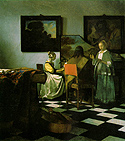
Vermeer's The Concert

Vermeer's The Concert