-------------------------------------------------------------------------------- Dr No, Hans Heinrich "Heini" Thyssen-Bornemisz’s Stolen & Looted Art Collection
Jan.
5 – Somewhere between 1970-1985, a piece of art valued at $218,000 was
stolen from BYU campus. After being stolen the “Silver Chalice” was
sold between a number of different art dealers before finally landing in
Switzerland with Count Thyssen-Bornemisz’s collection. BYU negotiated
with Thyssen-Bornemisz’s estate and the piece of art was returned to
BYU.
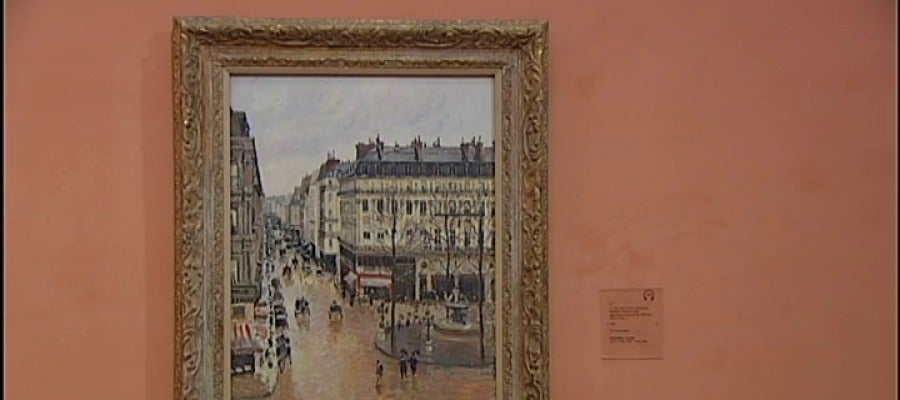
----------------------------------------------------------------------------- The Camille Pissarro painting hanging in the Thyssen-Bornemisza Collection Museum.
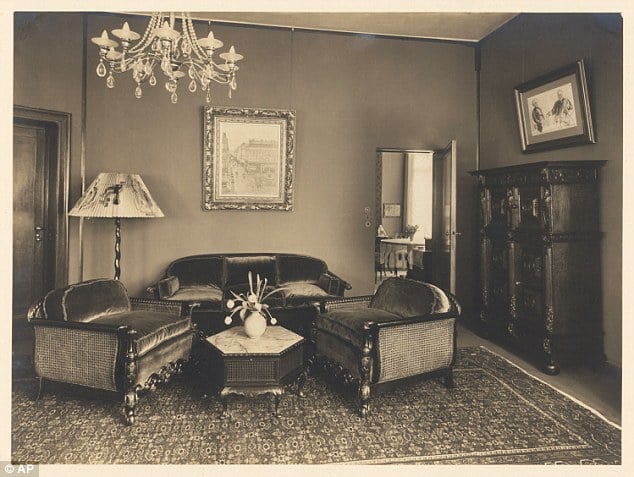
The Camille Pissarro painting hanging in the Berlin apartment of Lilly Cassirer, circa 1930.
Miami lawyer leads legal charge against Spain to return Pissarro painting looted by Nazis
Cassirer’s great grandson is fighting a legal battle with the Spanish
museum to return the painting. - The Cassirer Family Trust, public domain
Gazing through the window of his
Paris hotel room in 1897, influential Impressionist artist Camille
Pissarro painted a dreamy street scene alive with suited men,
horse-drawn carriages and bustling shops. More than a century later, the
St. Honoré St., Afternoon, Effect of Rain now hangs as a signature piece in Spain’s Thyssen-Bornemisza Museum.
But the oil-on-canvas masterpiece
has a dark past: the Nazis strong-armed it away from Lilly Cassirer,
whose prominent Jewish family owned an art gallery in Germany in the
1930s.
After years of legal
battles, the Cassirer family — with help from prominent Miami lawyer
Steve Zack — next week will finally get a chance to convince a federal
judge to order Spain to return the priceless work of art. Monday’s trial
in a Los Angeles federal court will be closely watched in the art
world, and for those who have fought for decades to return art looted by
the Nazis during the Holocaust.
For Zack, a former American Bar
Association and Florida Bar president, the case has special resonance.
He is Jewish. And Zack and his family were forced to flee Cuba by the
island’s Communist authoritarian regime.
“This is important in different
ways to many communities,” Zack said of the case. “Jewish and Cuban
families suffered, from the Nazis and the Casto regime. When we took on
this case, it had a significant meaning far beyond just one case.”
Tracking down Nazi-looted art has been a priority for world leaders, who this month celebrated the 20th anniversary of the Washington Principles, a treaty aimed at returning the pieces to their rightful owners.
Miami lawyer Stephen Zack
- Boies Schiller Flexner law firm
The Nazi regime stole an
estimated 600,000 paintings before and during World War II, Stuart E.
Eizenstat, a U.S. State Department adviser who helped establish the
treaty, said at the conference earlier this month. He told the
conference that at least 100,000 paintings remain unrecovered, according to the New York Times, and singled out five countries, including Spain, for resisting efforts to return art stolen by Hitler’s henchmen.
As U.S. deputy secretary of the
Treasury under the Clinton administration, Eizenstat urged Spain to
return the Cassirer family’s painting to no avail.
The odyssey of the Pissarro
painting began in 1900, when his exclusive agent sold the work to the
Cassirers, who owned a prominent gallery in Berlin. Lilly Cassirer
inherited the piece in 1926, and displayed it her parlor. By 1939, as
the Nazis were systematically destroying Jewish society and preparing to
unleash their war machine on Europe, Cassirer was forced to sell them
the painting for a paltry sum in exchange for safe passage out of
Germany.
During the war, the Nazis sold
the painting to an anonymous buyer. For decades, the Cassirers believed
the painting was lost, until a family friend in 2000 spotted it at the
Thyssen-Bornemisza museum.
So what happened? The painting —
today valued at at least $40 million — wound up in the hands of (Dr No) Baron
Hans Heinrich Thyssen-Bornemisza, a member of the famous German
industrialist family. Records show he had purchased the painting in 1976
from St. Louis collector Sydney Schoenberg through the Stephen Hahn
Gallery in New York.
Spain later bought
Thyssen-Bornemisza’s art collection for display at the government-run
museum that bears his name. The baron died in 2002. For years after the
painting was spotted, the Cassirer family repeatedly asked the museum to
return the painting.
It was not until 2005 that Claude
Cassirer, Lilly’s grandson, filed a federal lawsuit in Southern
California. A trial judge dismissed the case five years later, a
decision overturned in 2013 by a federal appeals court. Claude has since
died, but his son, David Cassirer, is now the plaintiff, along with the
United Jewish Federation of San Diego County.
“There is a widespread
recognition by civilized nations that is important to restore looted art
to the rightful owners. The Spanish government and the Spanish museum,
in this respect, is contrary to international norms. And frankly, it’s
reprehensible,” said lawyer David Boies , who also represents the
family..
Spain’s Thyssen-Bornemisza Musuem
cortesía
Leonardo Boix
In an unusual court room
scenario, the Los Angeles federal judge must rule under Spanish legal
standards. Spain and the museum will argue that Thyssen-Bornemisza
bought the masterpiece in good faith — that the baron never knew the
painting was ripped off from the family by the Nazis.
“No evidence of bad faith can be
found in the Baron’s ownership of the painting – during which time the
painting was publicized and publicly exhibited in international tours
between 1979 and 1986, and in the 1988 magazine Architectural Digest,”
the museum’s legal team, headed by Thaddeus Stauber, wrote in court
documents.
Stauber declined to comment before the trial.
The Cassirer family’s legal team must prove that museum was an encubrador — in Spanish law, an accessory to the theft of the art decades earlier.
They point out that
Thyssen-Bornemisza was a sophisticated art buyer who employed a cadre of
experts to examine works. When he bought the painting in New York, it
still had a label identifying it as part of the Cassirer Gallery in
Berlin. Within the art world, it was widely knownthat the Cassirer painting had been targeted by the Nazis.
“It was easy to find out this was looted,” Boies said.
In the years after the purchase,
Thyssen-Bornemisza also fudged details of the purchase to try and hide
that he knew the Pissarro was a stolen work of art, according to the
lawyers.
The trial is before U.S. District Judge John Walter, and is expected to last at least three days.
David
Cassirer is suing Spain’s Thyssen-Bornemisza Museum to recover a
valuable Pisarro painting that was stolen by the Nazis in 1939, and
later wound up hanging in the gallery.- Cassirer family.
The Gardner Art recovery needs to be taken out of the Govt/FBI and Gardner Museum's hands. The
private sector, in the shape of a Billionaire Philanthropist, needs to
step in with a private reward offer structured with a:
Philanthropist Gardner Art Reward Price List No conditions on reward payment No scrutiny.
All done with media co-operation in public. Banner headline the Philanthropist Gardner Art Reward Price List
Then
the Billionaire Philanthropist can hand back the stolen Gardner art
they recover, seek no Gardner Museum reward, and not reveal how they
recovered the said stolen Gardner artworks.
Introducing Jeffrey Gundlach, the Billionaire Philanthropist,
Renaissance Person whom I believe has the rescources and is best suited
to bring home the stolen Gardner Art, with a private reward offer to
counter the uncollectable Gardner Museum reward offer.
Not satisfied with just donating a record amount of money to the
Albright-Knox Art Gallery, philanthropist Jeffrey Gundlach now wants to
live near it.
The billionaire investment manager, who owns a $15 million estate in
the Pacific Palisades of Los Angeles, will use a 5,204-square-foot
mansion at 76 Lincoln Parkway as his home when in town.
Gundlach bought the 0.41-acre property through Frostridge LLC in 2017
from the estate of Susan F. Surdam, paying $950,000, and he's making
interior improvements.
The property is just a few blocks from the museum, but the founder of
DoubleLine Capital won't always be there, said attorney Sean Hopkins.
So now he's planning to carve out the rear 4,525-square-foot portion of
the property into a new lot, on which he'll put up a two-story detached
building with a three-car garage and a 1,120-square-foot caretaker's
apartment.
Both the existing 2.5-story house in front, which dates to 1926, and the new house in the rear will be stucco.
Plans by architect David Sutton call for adding a new uncovered porch
on the front facade of the existing house. The new balcony is designed
to mimic the home's original terrace and courtyard. The property is
in the Elmwood Village Historic District East.
If approved, construction by Omni-Craft Inc. – the Akron-based firm
owned by Gundlach's older brother, Drew – would cost $250,000 and would
last four months, according to an application to he Buffalo Planning
Board, which will review the project July 30.
The project received three variances from the Zoning Board of Appeals.
Gundlach donated $42.5 million to the Albright-Knox in 2016 to anchor
the museum's $100 million capital campaign, then added another $10
million commitment in 2017 when the museum increased its target to $155
million.
The
Gardner Museum reward offer started out as a private reward offer from
the auction houses Christies and Sotheby's so this would only be
reverting to the original private Gardner art reward offer. See link: https://www.nytimes.com/.../auctioneers-underwrite-reward...
Establish
an itemized reward price list showing the amount that will be received for
returning each of the stolen items, to accommodate the possibility that the 13 stolen
Gardner artworks are no longer together.
Reward Total $10 million
Vermeer
$5 million
Rembrandt
Storm on the Sea $3 million
Rembrandt
Lady and Gentleman in Black $1 million
Manet Chez
Tortoni $500,000
After
Rembrandt Obelisk painting $100,000
A bronze
eagle finial
(c. 1813–1814) $100,000
Small
Self-Portrait
by Rembrandt $50,000
An
ancient Chinese Gu $50,000
La Sortie
de Pesage
by Degas
$ 50,000
Cortege
aux Environs de Florence
by Degas $50,000
Three
Mounted Jockeys
by Degas
(c. 1885–1888) $50,000
Program
for an Artistic Soirée 1
by Degas
(1884) £25,000
Program
for an Artistic Soirée 2
by Degas
(1884) ~$25,000
Kelly Horan, host of Last Seen podcast about the Gardner Art Heist, reveals the tragic loss of the Gardner art can be compared to the tragic loss of the infant son of Isabella Stewart Gardner.
It is universally agreed that there is a desperate need to recover the Gardner art, however, until now no-one has offered practial solutions.
The Turbo Plan offers a solution going forward with the Gardner Art Reward Price List and Change .org petition:
When
I was given the assignment to delve into the story behind the theft of
13 treasures from the Isabella Stewart Gardner Museum — how did it
happen, and why hasn’t it been solved — I knew that my charge would be a
complicated one.
Working
with the Globe and my WBUR colleagues on a podcast about the crime, I
met mobsters and con men, wily defense lawyers and frustrated former
agents. I bounced between Dorchester and Ireland, the Fenway and New
York. I spent countless hours with the museum’s head of security, a man
whose every waking moment — his voice, his face, his somber demeanor —
is made heavy by his obsession with finding the stolen works.
I
basked in the live-wire glow of Anne Hawley, the brilliant and elegant
former museum director, who sized up the loss of the most valuable
paintings with a few unfathomable questions: What if we could never
listen to Beethoven’s Fifth Symphony again, or hear Louis Armstrong, or
see “Hamlet” performed? Such is the meaning of these missing Rembrandts,
the Vermeer and the Manet.
But the
most captivating person connected to the largest unsolved art heist in
history, someone whose presence I’ve felt every day of this endeavor, is
neither a suspect nor a detective. It’s Isabella Stewart Gardner
herself.
The French have a term for
the descriptive text left in place of art that has been stolen: fantôme.
As in, phantom. As in, the ghost of art now gone. Mrs. Gardner knew
loss, deep abiding loss, all too well. Which is what makes this robbery,
this fantôme, all the more wrenching. To understand Mrs. Gardner, as
she is still called at the museum, is to understand what was truly lost
on that March night 28 years ago.
Mrs.
Gardner was not an unsung presence in the Boston of the late 1800s. She
was wealthy, insatiably curious and the life of every party. But I
learned that before she was christened “one of the seven wonders of
Boston,” before she was described as a “flamelike incarnation of vigor
and life” in the thrilling portrait of her by the Swedish painter Anders
Zorn, she was nearly done in by death.
Anders Zorn's portrait of Isabella Stewart Gardner on display in the museum's Short Gallery. (Jesse Costa/WBUR)
Gardner
lost her only child, a son she called Jackie, before he was 2 years
old. It was the heartbreak of her life. In a photograph that I find
harder to look at than any of the museum’s empty frames, Gardner stands
behind her sitting baby, holding him up. Jackie looks straight ahead.
Gardner smiles into the back of the boy’s downy head. You can
practically see her inhaling his perfect baby scent.
In
1867, two years after their son’s death and on doctor’s orders, a wan
and bereft Gardner boarded a steamer ship with her husband, John Lowell
“Jack” Gardner. Destination: Northern Europe. Travel healed. Beauty
redeemed. And every couple of years, they did it again, abandoned Boston
for wilder shores and life-affirming art. Angkor Wat. The Nile. Venice.
Nothing could bring back a lost baby, but there he seemed to be, in the
face of the Christ child in Francisco de Zurbarán’s "The Virgin of
Mercy." Gardner bought that painting 23 years after Jackie’s death; she
never stopped looking for him.
I don’t
claim that every piece in Gardner’s vast collection was somehow
connected to her recollected son. Hunting after masterpieces — the
thrill of the chase, the ecstasy of possession — became her abiding
passion. “I suppose the picture-habit (which I seem to have) is as bad
as the morphine or the whiskey one — and it does cost,” she wrote to her
collector in Europe in 1896, as she awaited delivery of Titian’s
quivering, poignant Rape of Europa, for which she paid a record price of
20,000 pounds. (The Gardner thieves, blessedly, passed on this vast
masterwork.)
But
the whole of it — the books and tapestries and paintings and
sculptures, the Venetian palace she created in which to showcase it —
all of it was her bid to vanquish mortality. Death had claimed her only
child. It would also take her husband in 1898, just as they prepared to
buy the filled-in swampland in the Fens on which her museum would be
built.
The spirit may be eternal, but
the flesh is not. Leave it to Gardner, then, to have devised a
work-around for this earthly inconvenience: a last will and testament
that stipulated that her museum’s galleries should be left both “for the
education and enjoyment of the public forever,” and also unchanged —
nothing removed, nothing added.
“Don’t
touch!” an elderly Gardner is recalled as having called out to a passel
of visitors crossing her Raphael Room when her museum was still known
as Fenway Court. Upon her death, in 1924, Gardner made the sentiment
indelible. Nothing would touch or ever alter Isabella Stewart Gardner’s
stone-and-stucco monument — until two thieves dressed as police officers
did.
No mother loves all of her
children the same. Who’s to say which of the 13 lost works would cause
Gardner the most anguish? She’d written to her collector of feeling an
“ache” for the “sea picture,” as she called Rembrandt’s "Storm on the
Sea of Galilee." In acquiring Vermeer’s "The Concert," Gardner
established herself as a serious collector, even outbidding the Louvre.
But each of the stolen pieces was something she’d chosen and, we can
assume, cherished.
There are a few
show-stopping images of Isabella Stewart Gardner: that incandescent
Zorn; a John Singer Sargent portrait that so well captured Gardner’s
natural endowments it prompted her husband, otherwise tolerant of his
wife’s many flirtations, to banish it from public view. But that photo —
a young mother bashful with bliss — is my touchstone for what Gardner’s
collection meant to her and what its 13 missing pieces mean for all of
us.
She left them in our care. We need to get them back.
No place like home: 'Wizard of Oz' slippers found after Arizona donor offers reward
A scene from the 1939 classic
"The WIzard of Oz." Pictured from left: Ray Bolger (Scarecrow), Jack
Haley (Tin Man), Judy Garland (Dorothy) and Bert Lahr (Cowardly Lion).
MGM
It took 13 years, but the Federal Bureau of Investigation
followed the yellow brick road of clues and has recovered a stolen pair
of ruby slippers seen in the movie "The Wizard of Oz."
FBI Special Agent Jill Sanborn on Tuesday called the
recovery a "significant milestone" at a news conference in Minneapolis.
The bureau didn't say whether arrests have been made.
Sanborn said four pairs of ruby slippers are known to
exist: A pair at the Smithsonian, a pair owned by the Academy of Motion
Picture Arts and Sciences, a pair belonging to a private party and the
recently recovered "traveling pair."
"They are more than just a pair of slippers," said Grand
Rapids Police Department Chief Scott Johnson. "They are an enduring
symbol of the power of belief."
Stolen in 2005
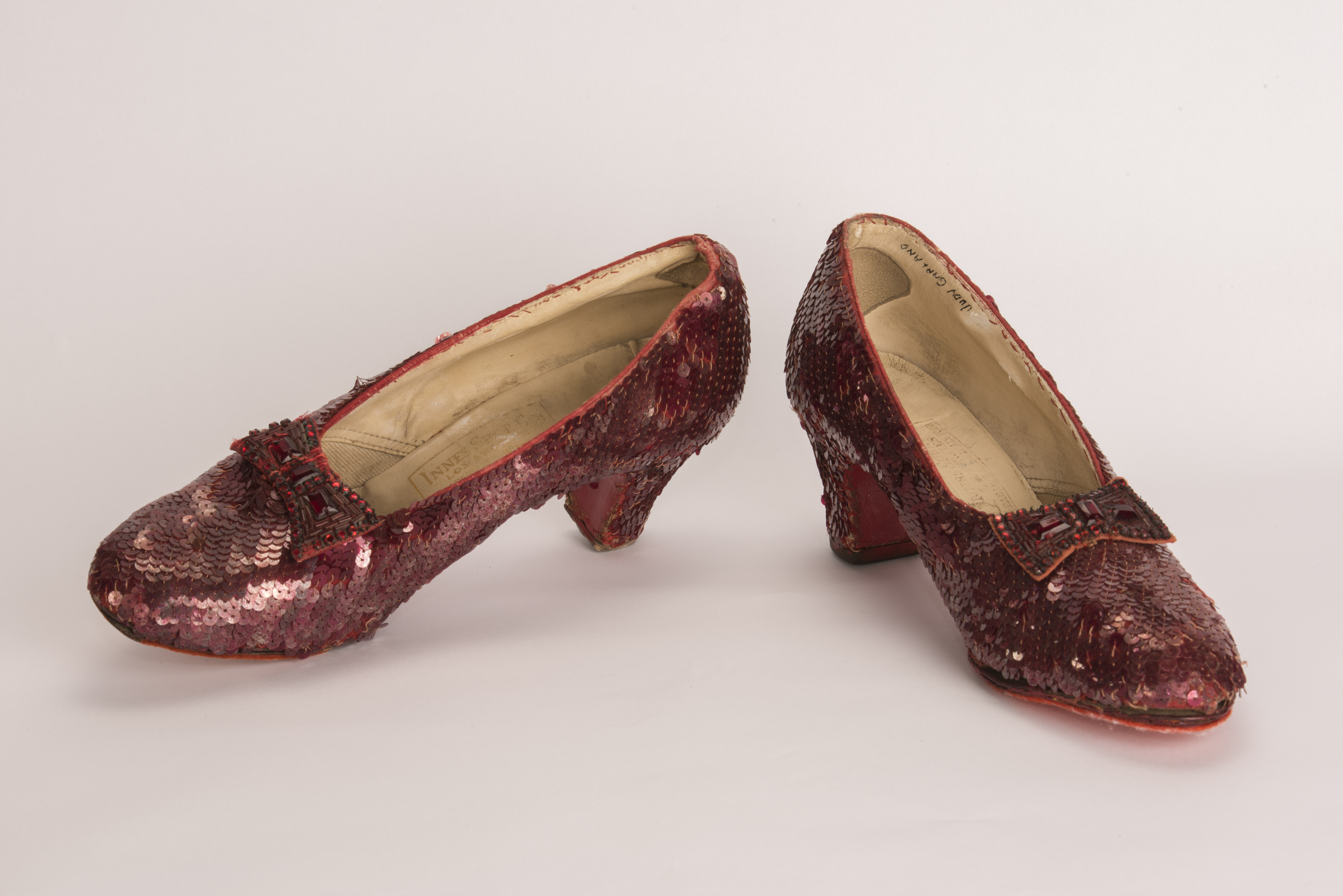
A pair of ruby slippers, known
as the "traveling pair," were recovered by the FBI after disappearing
from the Judy Garland Museum in Minnesota 13 years ago.
Courtesy of: Federal Bureau of Investigation
The shoes were stolen in 2005 from the Judy Garland Museum in Grand Rapids, Minnesota. The museum is Garland's childhood home.
"The thieves not only took the slippers, they took a
piece of history that will be forever connected to Grand Rapids and one
of our city's most famous children," Johnson said.
In 2017, a person provided information on the shoes and
how they could be returned. Investigators believed the person was trying
to extort the shoes' owners, according to a statement.
The FBI aided the investigation with its Art Crime Team,
laboratory, and field offices in Chicago, Atlanta and Miami. The bureau
said the shoes were found during an undercover operation in
Minneapolis.
The shoes were taken to the Smithsonian Institution's
National Museum of American History in Washington, D.C., to be compared
with another pair of ruby slippers.
Arizona reward in play?
Judy Garland as Dorothy, with Toto, in "The Wizard of Oz in 1939.
Metro-Goldwyn-Mayer
An anonymous Arizona donor in 2015 had offered a $1 million reward for information leading to the return of the slippers.
Judy Garland Museum Executive Director John Kelsch told The Arizona Republic at the time that the museum would not say whether the donor was from the Phoenix area.
The donor is a fan of Garland and "The Wizard of Oz." MORE: Ask Clay: Hidden messages in 'Wizard of Oz'
In his The Republic interview, Kelsch said to
claim the reward, the tipster must provide the slippers' exact location
or have someone personally turn them in. Also, the slippers must be in
good condition for authorities to authenticate them and the name of the
thief must be provided.
Museum officials couldn't say Tuesday whether the
recovery of the shoes fully met those criteria. Officials also
didn't provide an update on the reward.
Who stole the shoes?
The FBI is still looking for information on the theft of the slippers. Multiple suspects were identified.
"There are certainly people out there who have additional
knowledge regarding both the theft and the individuals responsible for
concealing the slippers all these years," FBI Special Agent Christopher
Dudley said.
The public is encouraged to provide information on the theft or extortion plot by calling 1-800-225-5324or submit information online at tips.fbi.gov.
Art crimes
U.S. Attorney Chris Myers said the FBI's stolen art
list contains about 8,000 art and culture items. Since the creation of
the Art Crime team, more than 14,850 items have been recovered.
"There is a certain romance in these types of schemes,"
Myers said. "Sometimes sophistication, but at the end of the day it is a
theft."
In 2017, a painting by Willem de Kooning was recovered at
an estate sale in New Mexico. The painting, stolen from the University
of Arizona Museum of Art in 1985, is estimated to be worth more than
$100 million.
Art Crime
Stolen Ruby Slippers from The Wizard of Oz Recovered
Dawn Wallace, a conservator for the Smithsonian
Institution's National Museum of American History, analyzes one of the
recovered slippers at the Smithsonian's Conservation Lab in Washington,
D.C. (Smithsonian photo)
A pair of ruby slippers worn by Judy Garland in the 1939 film The Wizard of Oz and stolen from the actress’ namesake museum in Minnesota more than a decade ago has been recovered, the FBI announced today.
The
iconic sequined shoes, known as the “traveling pair”—one of at least
four pairs used in the film that are still in existence—were stolen from
the Judy Garland Museum in Grand Rapids, Minnesota in 2005 and
recovered earlier this summer during a sting operation. But the case is
far from over.
“From the outset,” said Special Agent Christopher
Dudley, who led the investigation from the FBI’s Minneapolis Division,
“our top priority was the safe recovery of the slippers.” Although
multiple suspects have been identified, Dudley said, “we are still
working to ensure that we have identified all parties involved in both
the initial theft and the more recent extortion attempt for their
return. This is very much an active investigation.”
At a press
conference in Minneapolis to announce the recovery, the FBI, along with
the Grand Rapids Police Department, asked for the public’s assistance.
“There are certainly people out there who have additional knowledge
regarding both the theft and the individuals responsible for concealing
the slippers all these years.” Dudley said. “We are asking that you come
forward.”
Conservators at the National Museum of
American History assisted the Minneapolis Division of the FBI in the
case of ruby slippers from The Wizard of Oz that were stolen in
Minnesota in 2005. The museum analyzed and compared the recovered
slippers with a pair that has been part of the Smithsonian collection
since 1979.
“We are still working to ensure that we have identified
all parties involved in both the initial theft and the more recent
extortion attempt for their return.”
Christopher Dudley, special agent, FBI Minneapolis
Judy Garland, who played Dorothy Gale in the classic fairy tale film
enjoyed by generations of moviegoers around the world, wore several
pairs of the red slippers during the movie’s production, dancing her way
down the yellow brick road and, at the story’s end, clicking her heels
three times and repeating, “There’s no place like home.” The slippers
are widely considered to be one of the most recognizable pieces of
memorabilia in American film history, and are estimated to be worth
several million dollars.
The star’s childhood house in Grand Rapids was turned into a museum in 1975 and remains a repository of The Wizard of Oz
artifacts and memorabilia. The slippers disappeared from there in the
early morning hours of August 28, 2005, and the crime has weighed
heavily on the community, whose identity is proudly associated with
Garland’s birthplace.
Despite a vigorous investigation by local
authorities at the time, the slippers were not located, and no arrests
were made. When the theft occurred, said Grand Rapids Police Department
Chief Scott Johnson during today’s announcement, “the thieves not only
took the slippers, they took a piece of history that will be forever
connected to Grand Rapids and one of our city’s most famous children.”
In
the summer of 2017, 12 years after the theft, an individual approached
the company that insured the slippers, saying he had information about
the shoes and how they could be returned. “When it became apparent that
those involved were in reality attempting to extort the owners of the
slippers,” Dudley explained, Grand Rapids police requested the FBI’s
assistance. After nearly a yearlong investigation—with invaluable
assistance from the FBI’s Art Crime Team, the FBI Laboratory, and field
offices in Chicago, Atlanta, and Miami—the slippers were recovered
during an undercover operation in Minneapolis.
These iconic sequined shoes, known as the “traveling pair”—one of at least four pairs used in The Wizard of Oz
that are still in existence—were stolen from the Judy Garland Museum in
Grand Rapids, Minnesota in 2005 and recovered earlier this summer
during a sting operation.
Agents from the FBI’s Minneapolis Field Office transported the
recovered slippers to the Smithsonian Institution’s National Museum of
American History in Washington, D.C.—where another pair of the ruby
slippers has been on display since 1979—for analysis and comparison.
Dawn
Wallace, a Smithsonian conservator who has been working for the past
two years to conserve the museum’s ruby slippers, which are nearly 80
years old, said a careful analysis led to the conclusion that the
recovered shoes were similar in construction, materials, and condition
to the museum’s pair. And it turns out the recovered shoes and the pair
in the museum’s collection are mismatched twins.
Smithsonian
curator Ryan Lintelman, who specializes in American film history,
explained that there were probably six or more pairs of the slippers
made for The Wizard of Oz. “It was common that you would create
multiple copies of costumes and props,” he said. Somehow over the
years, the pairs of shoes were mixed up.
Lintelman added that the
Smithsonian’s ruby slippers “are among the most requested objects by
visitors to the museum. There is an emotional response that visitors
have,” he said. “People’s eyes light up.”
“Recovering a cultural
item of this importance is significant,” the FBI’s Dudley noted. “So
many people of all ages around the world have seen The Wizard of Oz and in that way have some connection to the slippers. That’s one of the things that makes this case resonate with so many.”
Anyone
with additional information regarding the theft of the ruby slippers or
the extortion plot is encouraged to contact the FBI at 1-800-CALL-FBI
(225-5324) or submit information online at tips.fbi.gov.
Art Hostage aka Turbo Paul having a chit-chat with Tim and Lance on Empty Frames podcast about the Gardner Art Heist and how to recover the stolen Gardner art. Empty Frames podcast
A West Virginia man who pleaded guilty to a wire fraud scam
purporting to sell paintings stolen from the Isabella Stewart Gardner
Museum was sentenced yesterday.
Todd Andrew Desper was sentenced
by U.S. District Court Judge Rya W. Zobel to time served and three years
of supervised release, three months of which will be spent in home
confinement, according to an announcement by U.S. Attorney Andrew E.
Lelling and Harold H. Shaw, Special Agent in Charge of the Federal
Bureau of Investigation, Boston Field Division.
Desper’s attorney didn’t immediately respond to an email.
Prosecutors
said Desper, acting under the pseudonym “Mordokwan,” solicited foreign
buyers on Craigslist for Rembrandt’s “Storm on the Sea of Galilee” and
Vermeer’s “The Concert,” two paintings he claimed were among 13 stolen
from Boston’s Isabella Stewart Gardner Museum in 1990.
According
to prosecutors, the security director for the Gardner Museum engaged in
encrypted communications with Desper in an attempt to determine whether
he had access to the stolen masterpieces. During the email exchange,
Desper instructed the security director to send a cashier’s check for $5
million to a location in West Virginia. In return, “Storm on the Sea of
Galilee” would then be sent, concealed behind another painting.
Investigators
were ultimately able to determine that Desper had no access to the
artwork, or any information about the notorious heist, but was instead
engaged in a multimillion-dollar fraud scheme targeting foreign art
buyers.
Desper pleaded guilty to wire fraud in February.
The
FBI has said two suspects who masqueraded as police officers to rob the
museum of $500 million worth of masterpieces are dead.
Federal
authorities were notified of the foreign Craigslist notices by
individuals seeking to assist in the recovery of the artwork, as well as
those seeking the multi-million dollar reward offered by the museum. Why No Gardner Art Recovery
Making public an unsubstantiated narrative that the Gardner Heist was by
local Boston criminal gangs was somehow supposed to help get the art back, but
what's left of these gangs are less inclined to cooperate with
authorities for a shot at the reward than ever. https://twitter.com/gardnerheist?lang=en
These Boston gang leftovers, along with anyone who could help recover the Gardner art do not, and have never, believed the offers of Immunity and Reward and both were designed to decieve.
Anyone who has stepped forward and tried to negociate a Gardner art recovery has been hounded, jailed and their life destroyed, whether deserved or not by their criminal lifestyle.
Everytime someone stepped forward they were led like Lambs to the slaughter, told there is only one deal, give up everything they know to authorities, be prepared to testify against those involved in the Gardner case and just hope and pray the Gardner Museum takes pity and decides to give a nominal reward, never millions of dollars as claimed.
What incentive does that give anyone who could really provide a Gardner art recovery?
The Immunity and reward offers have never been scrutinised and no journalist has dared to question the validity of either the Immunity or Reward offers. Art Hostage Comments:
It matters not what Art Hostage believes about the validity of the Immunity and Reward offers in the Gardner Art Heist case. The people who need convincing are those who hold or know the location of the Gardner art.
Until these people feel confident they can hand back the stolen Gardner art, collect the reward and not face scrutiny of authorities, the only Gardner recovery effort in town is one of seeking an informant to give a location of the Gardner art.
That has not worked for twenty eights years and counting.
I wish the Gardner Museum and authorities would just state clearly they will not allow the Gardner art to be handed back, reward paid in full, and no scrutiny of those handing back the Gardner art.
Amore to speak about Gardner Museum heist in Hingham
How the theft was carried out and where the
painting might possibly be at this moment will be a few of the topics
covered when Anthony Amore visits the Hingham Community Center on
Wednesday, May 9 at 7:30 p.m.
The world-acclaimed Gardner Museum in Boston is unique. With
most world-class art museums people flock to stare at historic paintings
by master artists. But at the Gardner Museum a good number of
ticket-buyers come to stare at empty frames... and a slice of New
England folklore.
In the early morning hours of March 18, 1990, a
pair of thieves disguised as police officers entered the Gardner Museum
and stole 13 works of art by world-renowned artists such as Rembrandt,
Vermeer, Manet, and Degas. The works, including Rembrandt’s Christ in
the Storm on the Sea of Galilee and Vermeer’s The Concert, are worth
more than $500 million. This remains the biggest unsolved art theft in
world history.
The Museum is offering a $10 million reward for
information leading to the recovery of the stolen works. It’s important
to note the reward is for recovering the paintings, not the apprehension
of the thieves. This is also the priority of Anthony Amore, Security
Director for the Gardner Museum.
“Speaking for the museum, we just
want our paintings back,” Amore said in a recent interview with Boston
magazine. “I would work as hard as can you can imagine to make sure that
the people who come forward, that their names are never exposed. We
have methods to do that, to pay the reward, so the person who gets it
isn’t named publicly.”
How the theft was carried out and where the
painting might possibly be at this moment will be a few of the topics
covered when Anthony Amore visits the Hingham Community Center on
Wednesday, May 9 at 7:30 p.m.
Twenty-eight years after the artwork
was stolen, the museum’s security chief thinks he knows who did it.
What has him stumped is where the paintings are now. “The idea of a
professional art thief, a cat burglar who goes and steals masterpieces,
is fiction,” said Amore. “It has nothing to do with people who want art
for their collection. It’s people stealing these things for money.”
In
2011, Amore spun off his historic art-crime research into his book
Stealing Rembrandts, co-authored with journalist Tom Mashberg. Hardly
any thieves who steal a masterpiece ever do it again, Amore says,
because they quickly discover they’re stuck with it. “If you steal
hugely recognizable art, you can’t fence it,” Amore says. “One small
piece of information could end this tomorrow.”
Anthony Amore
Despite some promising leads in the past, the Gardner theft of 1990
remains unsolved. The Museum, the FBI, and the US Attorney’s office are
still seeking viable leads that could result in safe return of the art.
Any little bit of information can help. “I’m not looking for someone
necessarily to call me and say, ‘Go to Locker 3 in this storage
facility,’” Amore said in his interview. “It’s like you put this puzzle
together, you start with the borders, and people are giving you pieces.
“If
you do puzzles, most of the time, there’s this one piece that’s just
like, now it’s all falling together,” he adds. “So I’m not necessarily
looking for the big aha! moment. I’m looking for the small aha!moments
that I can piece together.” Tickets to hear Anthony Amore speak at the Hingham Community Center are now on sale at $10 and are available online at www.hinghamcommunitycenter.org, by phone at 781-749-9786, and at the Hingham Community Center at 70 South Street in Hingham.
Art of the theft: Book illustrates Boston museum heist
BOSTON: A new illustrated book about the theft of $500 million worth of
artwork from Boston's Isabella Stewart Gardner Museum went on sale
Monday.
The 37-page book "Stolen" was created in response to
visitor requests for more information about the 13 pieces stolen in the
early morning hours of March 18, 1990, by two men posing as Boston
police officers.
No one has been charged and the theft remains the largest unsolved art theft in history.
The thieves tied up two guards then spent 81 minutes in the museum
before absconding with Vermeer's "The Concert," Rembrandt's "Christ in
the Storm on the Sea of Galilee" and Manet's "Chez Tortoni," as well as a
Chinese beaker and a Napoleonic eagle ornament.
The book
includes images and the background of each of the works as well as an
overview with before and after photos of the galleries from which they
were removed.
"Our intention for this book, with its images of
the stolen art, is to help keep these masterworks present until we can
celebrate their return," museum director Peggy Fogelman writes in the
foreword.
The book also includes an essay by museum security
director Anthony Amore, who reminds readers of the $10 million reward
for information that leads to the recovery of the art.
Donate: https://www.gardnermuseum.org/join-give
Gardner museum security chief to run for Mass. secretary of state
M. Scott Brauer/The New York Times
Anthony
Amore, the director of security at the Isabella Stewart Gardner Museum
in Boston, is the first GOP contender for Massachusetts secretary of
state this year.
By Matt Stout
Globe Correspondent
Anthony Amore, the security chief at the Isabella Stewart
Gardner Museum and a central figure in the institution’s search for its
stolen artwork, is priming a campaign for the Massachusetts secretary of
state’s office. .
Amore, 51,
who announced his campaign on Tuesday, is the first Republican contender
in the race that already features a Democratic primary between longtime
incumbent Secretary William F.Galvin and Boston City
Councilor Josh Zakim, viewed by some as perhaps Galvin’s most
high-profile challenge in his two-plus decades in office.
Amore, a Swampscott resident, said last year that he intended to challenge state Representative Lori A. Ehrlich, a Marblehead Democrat, as his first foray into politics. But in a Boston Globe interviewthis week,he said that shifted in recent months after conversations with party officials, calling the statewide racea “first-in-a-generation” opportunity.
Amore framed his pitch as bringing “fresh leadership” to the office, echoing an argument Zakim has used in his campaign.
“I think that the secretary of state has a primary campaign where
he’s going to have to fight. And at the same time, his opponent is a
career politician. That’s not something that I am,” Amore said.
“I think I’d bring to this race the same sort of thing Charlie Baker
brings to the governor’s office,” he said. “I think I could appeal to
the same side of voters.”
Amore’s pivot to the race marks the
state Republican party’s latest attempt to fill out its ticket under
Baker and Lieutenant Governor Karyn Polito.
State Representative
Keiko Orrall, one of the party’s national committee members, is
challenging state Treasurer Deborah Goldberg, while two Cape Cod
Republicans — Dan Shores and James “Jay” McMahon — are vying in a
primary to face Attorney General Maura Healey.
A Republican challenger has yet to emerge to run against state Auditor Suzanne Bump.
Amore
has headed security at the Gardner since 2005 — a stretch that has
plunged him into the public spotlight on several occasions. The museum
and law enforcement have made various appeals for help cracking the
infamous 1990 robbery, when thieves disguised as police officers talked
their way into the museum, tied up two guards, and stole 13 pieces,
including three works byRembrandt.
Before
Gardner, Amore worked at the Department of Homeland Security and the
Transportation Security Administration, primarily on security at Logan
Airport in the wake of the Sept. 11, 2001 terrorist attacks.
Amore said he plans to continue working at the Gardner — and search for the paintings — during his
campaign.