The ‘Sociopath’ Scholar Who Made Films of His Crimes Tried to Confess to America’s Most Famous Art Heist
Out
of Rikers and facing a bank robbery charge in Providence, he’s trying
to complete his masterpiece of ‘autobiographical fiction’ that began
with buying a dime bag.
“Don’t spoil a good story by telling the truth.”—Isabella Gardner, founder of Boston’s Gardner Museum.
In February 2017, Joe Gibbons sat in a
Greenwich Village restaurant and calmly confessed to a role in the largest art heist in American history.
Gibbons, a filmmaker and former MIT lecturer now in his mid-sixties—back in circulation after pleading guilty in 2014 to a
Manhattan
bank robbery and spending a year in jail—had already confessed and
would soon be charged with another bank robbery, this one in Providence,
Rhode Island.
He
was sitting with a Pulitzer-winning journalist, Stephen Kurkjian, and a
novelist, Charles Pinning, both of whom had traveled from New England
and knocked on his door that afternoon. Their visit came weeks after an
assistant U.S. attorney in
Massachusetts had called Gibbons’ lawyer to inquire about his possible involvement in the Isabella Gardner Museum heist.
In March of 1990, a security guard at the Boston museum let
in two thieves dressed as police officers who proceeded to steal $500
million worth of art, including works by
Rembrandt,
Vermeer, and
Degas. The guard, who now lives in Vermont, was never charged and has long denied any involvement in the heist.
Twenty-seven
years later, Gibbons, chasing a morning’s worth of Jameson down with a
Kir Royal, was toasted—“well lubricated,” he calls it—and ready to
confess.
Soon
after midnight on the morning following St. Patrick’s Day, 1990,
Gibbons told his audience of two, he was at the Gardner Museum, to score
a dime-dag from a security guard there he’d bought from before.The guard told him to walk with him into the closed museum’s
Blue Room with the promise of a dime bag, he said. There, several
masterpieces were spread across the floor. “I don’t know how to get them out of the frames,” he says the security guard told him. He stomped on Rembrandt’s
Christ in the Storm on the Sea of Galilee, the artist’s only known seascape.
“That’s not the way to do it!” Gibbons yelled.
The guard threw another piece of art on the floor, a Rembrandt sketch. “Do you want this one? Do you want this one?” he teased.
Gibbons
rejected the offer, he said, in part because he “wasn’t a big fan of
Rembrandt” but helped the guard pull off the caper. “I showed how you could remove the backings of the paintings and take the canvases out.”
His
wife walked into the restaurant, and cut the interview short, not
wanting her husband’s name attached to still another crime even as he
faces possible jail time for the Providence robbery. So Gibbons wrapped
it up, saying that he’d run out of the museum with a dime bag and
without any of the paintings.
Still, he had confessed, before two writers to his role in the white whale of a crime that’s filled decades of
newspaper column inches,
TV-
news airtime and the
pages of
non-
fiction books with speculation about who done it.
Asked
about his involvement with Gibbons, Kurkjian told me in July that “I’m
no longer working with him and have asked that he not associate me with
the reporting any longer.” Pinning refused comment.
***
But
what to make of the confession of a criminal and artist who’s dedicated
both careers to his “autobiographical fiction” propagating the myth of
Joe Gibbons, artist, filmmaker and self-alleged criminal mastermind?
Gibbons
began to cultivate that myth in Oakland, 1977. Then in his early
twenties, he moved to the Bay Area after attending Antioch College in
Ohio. He was welcomed into the art scene and began making films. He also
kickstarted his career as a petty criminal.
The
intersection of his two careers garnered press attention when
Gibbons—well-lubricated at the time—grabbed a painting off the wall of
the Oakland Museum during an opening party for artist Richard
Diebenkorn.
Gibbons shoved the painting beneath his
coat, and waltzed past hundreds of party guests and the museum’s
security. The police tracked him down, but rather than go quietly, he
seized the opportunity.
He was a member of a renegade
group of six artists called the “Art Liberation Front,” Gibbons claimed.
The Front had a manifesto, dreamt up by Gibbons: They were critical of
the arbitrary value placed on a piece of art—but they were also
publicity hungry.
“We’re inveterate opportunists,” Gibbons
told the Berkeley Barb after the theft.
“Our philosophy is full of contradictions. It had nothing to do with
Diebenkorn—it was about museums in general. We saw the opportunity for
some publicity and we grabbed it.
“Basically we’re
creating meta-art, which is art about art,” he told the paper. “We are
whimsically critical of the art establishment as well as the art-critic
contingent, who view art solely in terms of its commodity function—its
exchange value versus its use value.”
By their logic,
the frame was the only piece of a painting that had any actual value.
Before the police caught up with him, The Front agreed they would return
the painting, but keep the frame hostage. One of their ransom demands,
the group told the
Barb, was for the Oakland Museum to hold an exhibition with nothing but frames.
That
crime, which Gibbons unquestionably committed, might draw someone to
believe he could’ve somehow been involved in the famous Gardner Museum
heist. Beyond the obvious art-crime connection, there are the frames. On
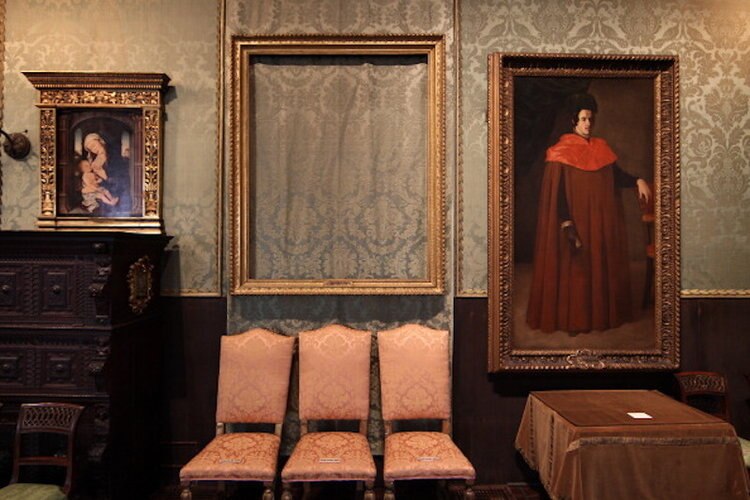
that early March morning in 1990, the Gardner Museum thieves cut the
paintings out and left the frames—which still hang there, with nothing
in them.
I
first connected with Gibbons through a Facebook message this summer.
I’d seen a news alert about a bank robbery in downtown Manhattan, and
Gibbons, who I’d covered as a reporter, popped into my head. I messaged
him, hoping to find out how he’d adjusted after jail. When we met
Washington Square Park on a recent afternoon, he recounted the story of
the two writers who knocked on his door in February, and produced a
recording of his confession.
“It’s an old myth the
artist has to have experiences, which he can then use for his material,”
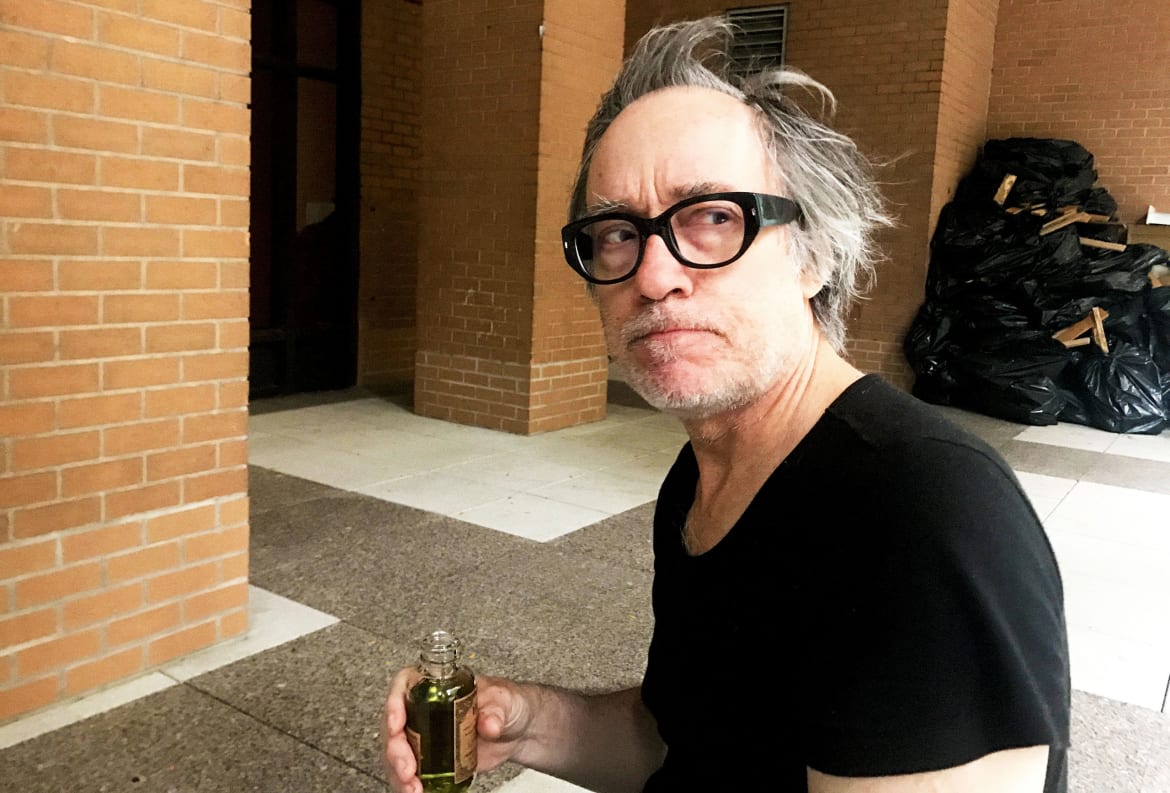
Gibbons told me between sips from a can of bubbly wine. His gray hair
was unkempt and long on the sides. He has few teeth left in his mouth.
“When
I was a teenager, I thought I was innocent and protected, my
upbringing,” he said. “I needed to really get dirty. Get my hands
dirty.”
In his films, Gibbons’ combined his dry wit and intellect with transgressive material.
“He
was always flirting with a certain amount of criminality. It was always
one of his subjects,” said noted film critic Jim Hoberman, who was one
of the first journalists to write about Gibbons’ work. “He was already
notorious for having stolen that painting” from the Oakland Museum.
Gibbons’
contemporaries in late 1970s and early 1980s in New York were creating
overtly sexual films in a trumped-up John Waters’ style, Hoberman said.
Gibbons,
on the other hand, was also exploring taboo subjects, but with wit and
nuance. “He was transgressive in a way that was much more interesting to
me,” Hoberman said. “His films were just much more interesting,
conceptually and visually. I was very supportive of them. I thought he
was doing something new.”
In his 1978 film,
Spying,
for example, Gibbons secretly recorded his neighbors in San Francisco
as they sunbathed, gardened, kissed one another, and did other routine
tasks.
The film flirted with the taboo of voyeurism, but also commented on American daily life.
When
it was screened by the film society of Lincoln Center in 2012, they
published critiques of the film by Hoberman and filmmakers who knew
Gibbons’ work.
“It’s an aggressive film in its Rear
Window quality,” wrote artist Peggy Ahwesh, “but also a film that
exposes the pathos of a loner as he gazes on to the lives of others who
are active, have relationships, lovers, pets and manage to accomplish
the small tasks of daily life. Spying is the ultimate home movie.”
Away from the camera, Gibbons continued to find new material in his own criminality.
After
the Oakland Museum theft, Gibbons began stealing books at shops along
Telegraph Avenue near the University of Berkeley’s campus, in part to
pay for lawyer fees, he said. He would also steal champagne, his drink
of choice.
The book thefts were a clever scam, Gibbons
said. He would take an academic book from a shop and immediately flip it
at another store, sometimes for a several-hundred dollar payout.
He
went on to plead guilty in 1979 to a felony for stealing the Diebenkorn
painting, and was offered a deal to complete a drug-treatment program
in lieu of a prison sentence.
“The court gave me the opportunity of spending a year in a therapeutic community, or a year in Santa Rita jail,” he said.
Gibbons,
raised in Providence, moved back to the East Coast and entered the
McLean Psychiatric Hospital. When he completed the program in 1980, he
spent a short time in a New York City halfway house and reverted back to
his petty crimes, he said.
“The triggers were still
there. I immediately went back to stealing books,” he said. “I was, as I
say, conducting research, having experiences I could later distill into
art.”
After five months in New York, Gibbons moved to
Boston, where his avant-garde film career flourished as he made films
based on his actual experiences, conflated for effect. “I used the
circumstances that I found myself in as a base for fiction,” he said.
As he racked up parking tickets in Boston and in Rhode Island in the 1980s, his film
A Fugitive in Paris opens with him jumping out of a window, running from the Boston Police after him because of them.
The film also goes on to explore another crime Gibbons had yet to commit at that point in his life: bank robbery.
His
work in this period would be shown in New York’s Museum of Modern Art
and the Whitney Biennial. He won a Guggenheim Fellowship and received a
range of praise and criticism from critics.
His most acclaimed work,
Confessions of a Sociopath,
was released in 2001. It includes a number of old recordings, shot at
various points in Gibbons’ life, that show him appearing to break the
law in different ways. In one scene he shoots heroin; in another he
steals a book.
Gibbons earned the Guggenheim Fellowship
soon after the film was released and started the most stable job he ever
held: a lecturing position at MIT.
“I had ruled out teaching, but I’d gotten an MFA because the only way I could finish my film,
The Genius was by getting a staffer’s loan,” he said.
He
would spend nearly a decade in the lecturing role in MIT’s Art,
Culture, and Technology program, but was forced to leave in 2010 because
he didn’t earn tenure.
“I would’ve liked to continue there,” he said. “Nine years is the limit for a not-tenured.”
Gibbons
returned to producing avant-garde films full time after he left MIT,
but struggled to achieve the same success he had earlier in his career.
In
November 2014, Gibbons walked into a Providence bank, stood in line,
passed the teller a robbery note and walked away with almost $3,000, he
said.
“I could just go in and stand in line. That’s what
allowed me to follow through with it,” he recounted. “So I went through
with it and it worked out as I imagined it.”
Gibbons’ fascination with crime was part of his motive, he said.
“Bank
robbery was something that always had a mystique that represented to me
the pinnacle of criminal achievement,” he said. “It sort’ve represented
an achievement because it’s sort of the opposite of the way I was
raised.”
After the Providence bank robbery, Gibbons
traveled to New York, where he says he stayed in budget hotels in
downtown Manhattan and drank heavily.
Weeks later, he was again out of money and options, he said.
“I
ran out of people I could ask for money. I had to leave the place I was
staying because either I couldn’t afford it or I wasn’t welcome there
anymore,” he said. “What would be more stressful? Going to the men’s
shelter at Bellevue or robbing a bank?”
He answered his
own question by walking into a bank in Manhattan’s Chinatown on the
afternoon of New Year’s Eve day 2014, standing in line before passing
the teller a note demanding cash. Another customer happened to walk up
to the counter at the same time and distracted the bank attendant. To
refocus the attendant’s attention, Gibbons lifted his hands onto the
counter and revealed a small video camera recording his heist, in which
he walked off with $1,002.
After he was arrested days
later, Gibbons told the NYPD he’d committed the Manhattan bank robbery,
and also the one he’s now charged with in Providence. He pleaded guilty
in the New York case in July 2015, and was sentenced to a year in jail
with credit for the six months he had already served.
When
Gibbons walked out of Rikers Island in September of 2015, he hoped he
was due for a big promotion in his entwined film and petty crime
careers.
His arrest had made a splash in the press after
the New York tabloids first reported the crime. The story would go on
to be covered in
The New York Times,
People magazine, and in an exhaustive
Boston magazine profile. A documentary film crew even wanted to capture his post-incarceration life through their lens.
The myth of Joe Gibbons was growing again.
He
earned a new nickname in jail—Joey Banks—that’s now the greeting on his
cellphone voicemail. He’s identified himself as a “bank
robber/insurgent artist” on LinkedIn.
Maybe he could write a book. Or make a movie out of this.
But catch up with Gibbons today and he doesn’t seem like an artist poised to make a comeback.
Since
his release, he’s married Deb Meehan, also a filmmaker who currently
teaches at Pratt University and who he’s known for decades. There’s
visible friction between them, as she works to get him sober and keep
him out of jail, and he drinks, confesses to crimes, and recounts his
criminal past to reporters.
Gibbons was charged in the
Providence robbery in July, pleaded not guilty, and posted a $50,000
bond, a Rhode Island court spokesperson said.
He shares a
Greenwich Village apartment with Meehan, not far from a liquor depot
where he buys boxed and canned wine. He carried a tote bag to fill on a
recent afternoon trip to the store, and paid for the wine with what he
said was his wife’s credit card, instead of pocketing it like he
might’ve done years ago.
Even drunk and down on his
luck, he transitions seamlessly in conversation from tales of his bank
robberies to critiques of the Austrian philosopher Ludwig Wittgenstein.
And he still flirts with crime as material.
“I’m
just out and about, practicing my trade,” he said in a recent email,
attaching a photo of himself inside a Chase bank, holding up a deposit
slip. “Robbery—large bills only,” was scribbled on it.
He signed the email: “Joey Banks.”
But
drunk or sober, Gibbons’ eyes light up when he talks about the Gardner
Museum. Like the writers who sat with him in February, he saw
opportunity in his possible involvement in the famous heist. Not for
cutting a deal with the U.S. attorney for a reduced sentence in his
Providence bank-robbing case. Not for finally solving the decades-old
mystery. But for an autobiographical fiction film. For rekindling the
myth of Joe Gibbons.
“It was just better than gold,” he said, recounting his February confession.
Gibbons
took a trip to the Gardner Museum with his wife after the interview,
and playfully posed in front of the frame of the missing Rembrandt. His
lawyer later told him he has a “dangerous sense of play,” Gibbons said.
“I asked him if he knew someone looking for a Vermeer at cut-rate
prices.
“I would like to reconstruct it,” Gibbons said of
the heist. “I would re-enact it with the police uniforms. I don’t know
how far I could carry it.”
It wouldn’t be the first time Gibbons donned a police uniform for one of his films. In a scene from
Confessions of a Sociopath, a camera pans up to reveal a mustachioed Gibbons in full police regalia.
In a sketch released by police after the Gardner heist, one of the suspects sports a similar mustache and look.
Think
about his criminal past, his films, his art theft, and an audience
might see Gibbons in that sketch. They might believe for a second he
could’ve been there, perhaps even with a video camera in hand, the night
$500 million of art vanished.
That’s exactly what he would want.
Judge Orders Another Exam For Mobster Gentile, Who Remains Silent On Notorious Gardner Heist
A federal judge has ordered another competency evaluation of Robert Gentile, the geriatric
Hartford
gangster who authorities suspect is concealing information about
history's richest art theft, the heist a quarter century ago of $500
million in paintings and other works from Boston's Isabella Stewart
Gardner Museum.
The 81-year-old Gentile's lawyer expressed concern
about his mental acuity earlier this month, after he said Gentile was
confused and belligerent when he appeared in court in Hartford for
sentencing on weapons charges.
"Based on the representations of
defense counsel concerning the defendant's symptoms, there is reasonable
cause to believe he may presently be suffering from a mental disease or
defect that renders him mentally incompetent to the extent that he is
unable to understand the nature and consequences of the proceedings
against him or assist properly in his defense," U.S. District Judge
Robert N. Chatigny wrote in an order filed Thursday.
Gentile's
mental state has been a recurring issue in recent years, as FBI agents
hit him repeatedly with drug and gun charges, pressing him — without
success — for information that could lead to recovery of the works by
Vermeer, Rembrandt and others that disappeared after the 1990 robbery.
His lawyer, A. Ryan McGuigan, said Gentile — who has been locked up for most of the last five years — has displayed signs of
dementia
as his physical health has deteriorated in jail. In court earlier this
month, McGuigan said Gentile could not remember having pleaded guilty in
April to the gun charges and became angry when told he had.
Federal
prosecutor John Durham has suggested Gentile is feigning in an effort
to avoid another long prison stretch. Durham said that Gentile seemed in
control of his faculties in August when he was recorded on a telephone
call to his wife from the state jail in
Bridgeport, where he has been held since another competency evaluation last spring.
Durham
said Gentile was able to explain to his wife why and how he would be
sentenced. He also asked her to have money deposited in his prison
commissary account, Durham said.
Chatigny ordered Gentile sent to a
federal prison medical center — preferably the institution at Butner,
N.C. — for a 30-day evaluation. How the court proceeds with the gun
charges will depend on the evaluation. It will be Gentile's second visit
to Butner.
His first was last year, after he became confused and
was reported to be near death from a variety of ailments — notably
obesity — while being held at a federal jail in Rhode Island. He made a
remarkable recovery and lost about 60 pounds, according to close
associates.
But they said his health has deteriorated and his
weight has increased since his release from Butner and return to the
Bridgeport jail.